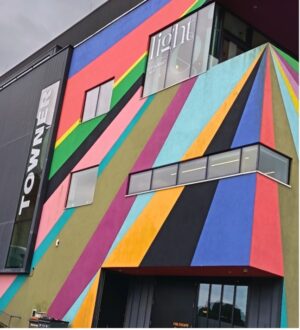
The Towner Gallery, in both its past and present forms, has been part of Eastbourne since opening in 1923. It was established from a bequest by John Chisholm Towner, a local Alderman.
The original site in Manor Gardens held the collection of work mainly depicting the countryside and animals, until 2005 when the building was sold. Eventually, in 2009, the brand-new purpose-built gallery we see today opened. At the time of the original’s closure, there was local debate over whether the correct decision had been made and many art lovers felt a part of local history was being abandoned. There is plenty more that can be discovered about the history of the Towner, but perhaps less is known about what goes on behind the scenes. What makes the gallery tick and contributes to making it, as described by ITV news in 2017, the region’s biggest art Gallery? It is larger even than the Turner Gallery in Margate, which is perhaps better known.
To find out more about what it takes to manage the collection, curate the exhibitions and discover the vast number, over 5000, works the gallery houses, I took an Art Store Tour. Tours run regularly and last about an hour. Our’s was a little longer as questions are welcome. There is also the opportunity to arrange private tours, which can be tailored to the particular interests of the group. This could be, just for example, education or design.
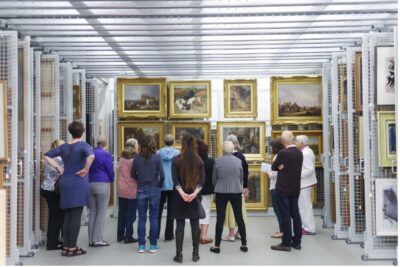
The store is accessed by very large doors, and the works reach it, usually, by an equally large lift. This is not always possible and it was explained that a seascape by John Virtue (over four metres long) was simply too vast to fit. All concerned were relieved when it was safely in position in the store, as it had to be ‘ carefully handled up the staircase.’
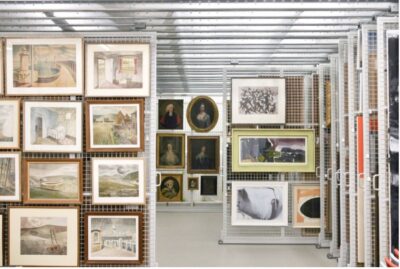
The racks themselves are floor-to-ceiling and slide out for ease of access. Each work has a label giving relevant information. The variety of the works is not just in the art itself but in the way it is mounted. The framing of the earlier pieces, often scenes reflecting Sussex’s coast and countryside with cows featuring heavily, had elaborate gilding and ornate carving. This style gives way to simpler designs as the modern era draws nearer. Works by artists, some obviously well-known, like our local Ravilious (who, I was not aware, died at only 39) and others I confess I have never heard of, are grouped together when they are relevant to and complement each other. It is possible, even to someone like me who knows little about art, to see how ideas change over time. The first abstract and modernist works appeared from 1958 to 1964 at Manor Gardens when William Gear, himself an abstract painter, was curator. Apparently, there was considerable local resistance from those who perceived that such innovative works went against the gentler image of the gallery they wished to preserve.
It was not possible to view the contents of all the huge racks but we were shown a selection of the many forms and mediums. At the moment, only 18% of the pieces are by women artists but it is hoped this percentage will increase. Maintaining such a large collection is a task that requires around fifty staff. This includes part-time and equates to about thirty full-time positions. There are also some fifty volunteers in various roles. There are no resident conservationists so specialists are engaged on a case-by-case basis when necessary.
With such a vast body of work, deciding what to display and how best to present it can be a lengthy business. Sometimes pieces are acquired on loan from other institutions to complement those in-house, just as Towner will loan to other galleries too. Large-scale exhibitions generally have a lead-in of two to three years especially when significant loans are required as there are practical issues involved. When the exhibition is solely from the in-house collection, this can be shorter although the research and development required by the curators can vary, affecting the timescale. Exhibitions are sometimes curated by guests, these may be artists themselves or, as with Caroline Lucas in 2020, someone with a clear focus on the climate. Her exhibition ‘Brink’ drew pieces together representing environmental concerns.
The most well-known exhibition held is the Turner Prize in 2023, which coincided with the centenary of the gallery. This was the first time the prize had travelled beyond London and acquiring it was achieved after a competitive and lengthy bidding process with other towns, cities and institutions. Until April, the gallery is hosting ‘Impressions in Watercolour’, celebrating the work of JMW Turner and his contemporaries. This is in association with The Holburne Museum in Bath and includes watercolours from the Towner Collection.
Not all the works stored will be displayed as there is not enough space to do so and exhibitions require external pieces to supplement the gallery’s own and ensure the most comprehensive representation of the artists’ work. An Art Store Tour gives the opportunity not only for a much wider viewing of the collection but also for perspective and context. It contains not only paintings but also ceramics and sculptures that have been displayed, will be displayed or held until they fit in with future plans. As well as storage, it is here that the work of repair and restoration takes place.

The move from the old gallery to a new space with state-of-the-art features, meant work could be held that, without optimum atmospheric conditions, would deteriorate. Such storage and necessary maintenance would not have been possible in the original building. The costs of this have increased significantly in recent years, particularly regarding the energy outlay needed to maintain humidity and temperature levels. With funding support solar panels have been installed but these are, at the moment at least, only able to generate 10% of the costs involved. The gallery, in addition to its funding streams, supplements its income from product development such as Custom Print but this is a very small part. Some income is also obtained from image licensing and the aim is to make much more of the collection available to view online so potentially increasing revenue.
We were asked at the beginning of the tour to consider, as we looked around, if there was one particular piece we would like to take home. At the end, the choices, and reasons for them, were varied. I chose an earlier work by Ravilious of woodland – in his recognisable style. The muted greens would definitely suit my living room. Unfortunately, there is not a print of my choice available. The look behind the scenes of such a prominent Eastbourne building is enlightening and shows that beyond what visitors see on display, in the gift shop and the cinema there is an incredible amount of work involved in running such a resource.
The Art Store Tour is bookable online and costs £11. Becoming a Turner Member currently costs £40 for Individual, £55 for Joint and £50 for Individual and one guest. Membership gives unlimited free entry to paid exhibitions, invitations to exclusive viewings and 10% discount in the gift shop, café and Light Restaurant. Tickets are also discounted for the cinema.
Definitely worth a visit and certainly much more to learn.
(All photos kindly provided by the Towner Gallery)


What a wonderful piece of local history! It’s amazing to see how the Towner Gallery has been such a constant presence in Eastbourne for so long.