By Ranjit Shergill 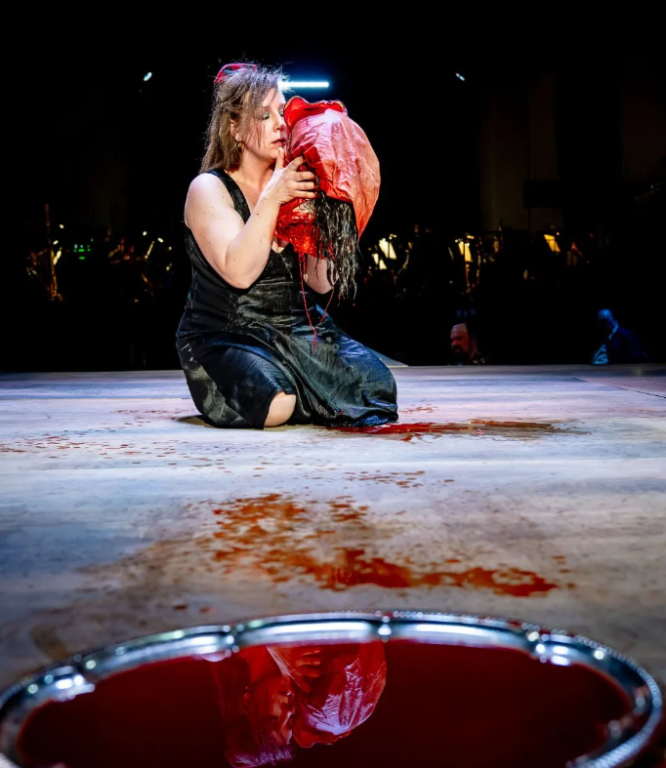
York Hall in Bethnal Green, East London was the venue for Richard Strauss’s Salome. York Hall was once a storied den for many a famous boxer learning their early career skills. The likes of Anthony Joshua and Tyson Fury have fought here. It was therefore fitting that the storyline of Salome would play out as a bloodied bout.
The seating arrangements were representative of an old school London theatre, whereby the audience could immerse themselves within touching distance of the cast. This was especially advantageous on the opening evening of such a vividly graphic performance.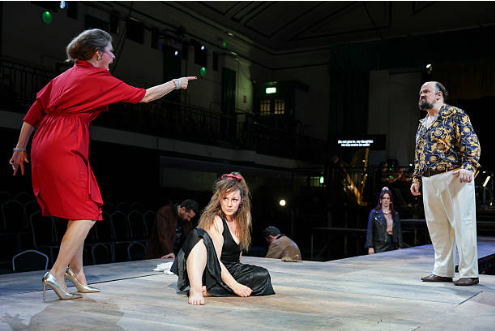
Richard Strauss’s Salome is a one-act opera that turns Oscar Wilde’s symbolist play into an ultra-intense music drama. Just below the front of the stage in the lead up to show time, was what initially appeared to be an attendant meticulously sweeping the same spots as though it had been subjected to profuse beverage overspill. Only after several minutes did it become apparent that this was part of the opening act and momentarily created a sense of organisation and not opportunism that was to come.
The opening scene sees John the Baptist (aka Jochanaan, played by Freddie Tong) paraded along the stage, and then piledriven into a cistern by Herodes’s (Tetrarch of Galilee, played by Robin Whitehouse) henchmen.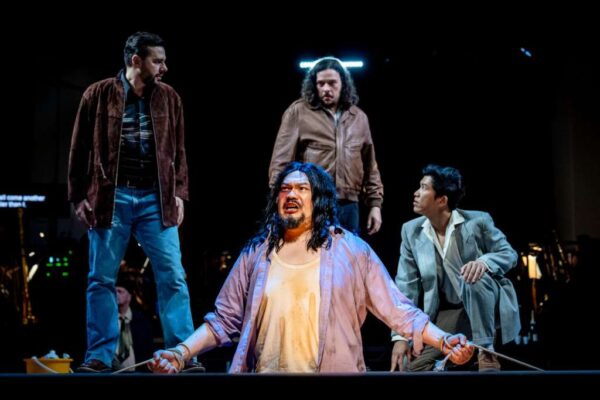
Salome (played by Kirsty Taylor-Stokes), stepdaughter of Herodes, becomes fixated on the imprisoned prophet, Jochanaan. She demands he be brought out from his cell, praises his body, then his hair, then begs to kiss his mouth. When he perpetually curses her, it only serves to ramp up her pursuit.
At this point, Salome turns to Herodes and begins exploiting his weakness. Herodes’s focus was on his incestuous obsession with Salome, and he was unashamedly unapologetic about it, thriving on her performing the dance of the seven veils. In return, Salome then had the liberty to demand that Herodes fulfils any one of her wishes.
There was no time for Herodes to have any nostalgic reflection, because the ultimate aim of the performance was not lost on him. Immediately upon conclusion of the dance, Salome with the help of her mother (Herodias, played by Mae Heydorn), attempted to verbally intoxicate Herodes, resorting to vitriolic repetition of Salome’s craving to have Jochanaan’s severed head on a silver charger in the palm of her hands, to therefore realise her definition of love with him. Herodias had long yearned for Jochanaan to be executed, as he did not approve of her marriage to Salome’s father. In essence you had mother and daughter campaigning for a mutually beneficial outcome.
Subsequently, Jochanaan is beheaded and his head is presented in an unceremonious bloodied state that Salome kisses. A tumultuous operatic composition that draws on morbidity, lust and obsession to descend into a deadly toxic whirlpool.
An apt description of the music is that it was a thunderous tsunami with chords that almost resonated with musical cacophony. It had the power to mesmerise the audience into accepting that this was a unique operatic experience that unwittingly challenged boundaries of past decades.
To be positively startled by a raucous atmosphere in a compelling storyline, click here


