
Way back in 2009 as part of my arts degree I was studying the art of the sami of north Scandinavia. Their culture is ancient and goes back thousands of years. As part of this they made petroglyphs at a place in Norway called Alta. I travelled up there to see this breathtaking work of art, surrounded by fjords. The glyphs are spread over rock faces trailing down to the sea, showing very facets of life from this age
Many years later I decided to follow up the research I had carried out by making a petroglyph of my own. My usual work is a mix of watercolour and oil landscape painting, but one of the ideas I carried with me from my time with the sami was that to truly represent nature you had to be part of it.
After much searching throughout the Downs of Kent and the Saracen stones scattered about it, and contacting landowners, where good rocks were located, I got permission from the Woodland Trust to use one of their stones to make my work on.

The rock is on the edge of a wood, next to a beautiful field wild and alive as a nature reserve, high up on the Downs and far from the encroaching towns nearby. I had a rough idea of what I wanted the glyph to depict, and settled down to start engraving on the old hard stone. I had decided to depict the name of the place, Hucking and looked into its meaning.
It comes from the name Huck, the ing part of the name just meaning “of the tribe of the Ingovanes.” This personal name could have been male or female, so using this uncertainty and the woodland setting I thought I’d draw a rough abstract image depicting the northern creation myth of man and woman from an ash and elm trees. Armed with my rough sketches I set to work on the rock.
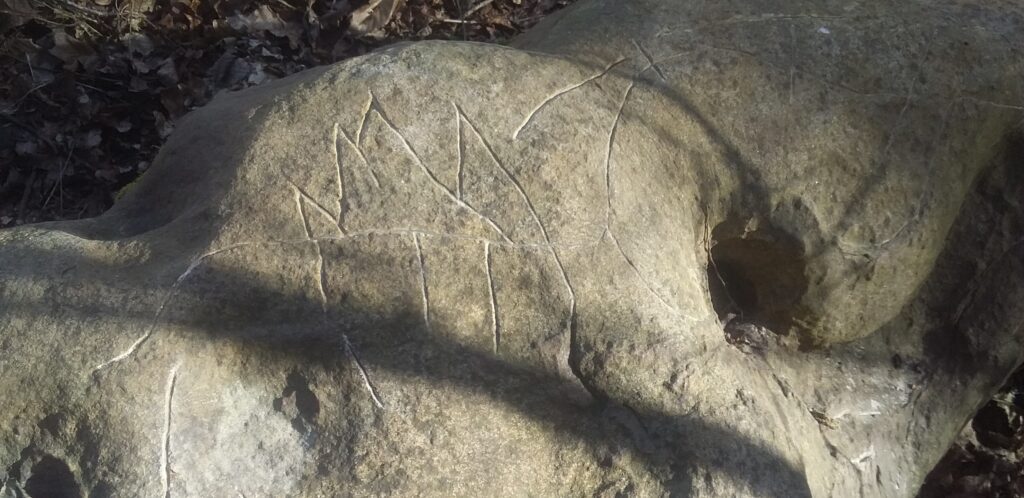
The first few weeks were mostly getting to know my rock, the slight contours and bumps, hollows waiting to be explored and incorporated into the drawing. As each week went by the stone went from being an inamate object to something that was alive. I had to slowly ease its secrets out of it and bring its hidden story to life.
At the same time the place began to seep into my soul. I became acutely aware of the seasons passing. Summer gave way to melancholic mists and reflections of autumn, before the wild slept for winter. Spring found the bluebells loudly announcing the new season with the sky and ground becoming a mirror of each other.
Life teemed round me. Small crawling insects were attracted to vibrations of the hammer of stone, and gently persuaded to leave. Birds flocked across the valley sky, while curious magpies explored the ever changing grasslands. Foxes and squirrels stalked the stranger in their midst.
I stopped feeling like a guest in this place, but a part of it, a part of nature. I sense the life around me, not only the animals and trees, but the very soul of the woods. Now, every time I return to our world it feels strange and unnatural, a horror of sorts.

I continue to work away every week on the project, now it is not so much about completing the idea of the drawing, but getting drawn deeper and deeper into the world of the valley. I feel that in a way I have connected with those artists from so long ago at Alta and across the world from ancient times, and the true reason for making art like this is not the finished work, but the journey.


