Sunday 22nd March was World Water Day. To mark this Seven Sisters Country Park, now a Nature Reserve and the first groundwater-inspired reserve of its kind, hosted several exhibitions related to this precious resource. A few days earlier, King Charles visited the Park to launch The King Charles III England Coast Path. A visit by the monarch is not something that happens often but throughout the year at Seven Sisters there are events that enable visitors to discover more about this special place.
Along with eight others, I attended a walk to learn more about the dew ponds of the Country Park. These are not exclusive to Sussex, also being found in Hampshire, Derbyshire, Staffordshire and Nottinghamshire. The walk was preceded by a talk given by David Riviere, who joined us. David has written a book – ‘Dew Ponds’ so is very knowledgeable. The walk aimed to visit three ponds within the Cuckmere Valley and was led by Will Johanson, who works as Ponds and Engagement Ranger for South Downs National Park Authority (SDNPA). His role is to create and restore ponds in the Central and Western Downs with funding from The ‘Downs to the Sea Project’ provided by the National Lottery Heritage Fund.
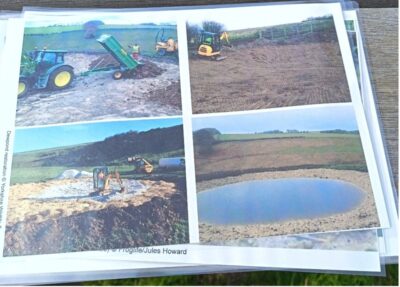
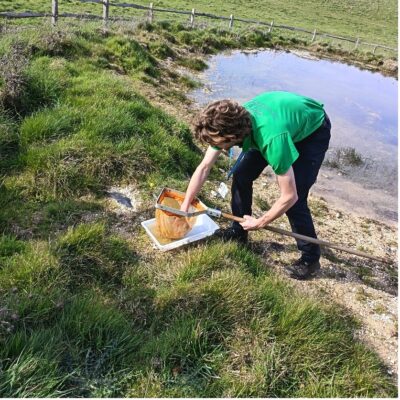
Becca from the SDNPA, armed with a tray and a net to allow us to see what thrives in these curious features, joined Will. The 280 hectares of the park contain many habitats — chalk downland, flood -plain meadows and wetlands. On the way to the first pond, Will gave us some background. The ponds are not significantly filled by dew but by rainwater. They are also called ‘mist-ponds’ and ‘ship-ponds’ – deriving from sheep. Those on the South Downs were mainly created in the 18th and 19thcenturies by professional dew pond builders to provide water for the livestock. The usual method of construction involved a layer of straw, then compacted ‘puddle clay’ in the saucer-shaped excavations. The Enclosure Acts of the same period meant traditional watering points were no longer accessible as land ownership was concentrated into fewer hands. However, construction likely took place from prehistory to serve communities where there were no natural water sources.
As agricultural methods changed – with food security, transition to cereal crops and troughs with piped water, the ponds were largely redundant, so management ceased. Some 70% were lost, and those that remained were, without maintenance, in very poor condition.
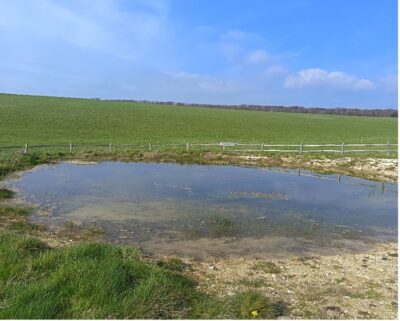
The Pounds for Ponds initiative, led by the SDNP Trust, aims to raise funds to restore 100 historic dew ponds in Sussex and Hampshire by 2030. Ponds are vital to help reverse the decline in freshwater habitats, and, as we discovered in the New Pond created only in 2025, it doesn’t take long for nature to move in. This was the first pond we visited. It took about twenty-five minutes to walk there over the slopes which, as all regular visitors know, can be challenging in certain weather conditions. Fortunately, the walk was not too arduous and relatively mud-free.
The site for this pond, as yet unnamed, with options apparently being considered, was chosen due to the aspect of the land and the relative proximity to New Barn Pond further along the valley. It was aimed to visit this one too, but we spent perhaps longer than intended inspecting the mini creatures that have already colonised New Pond.
Here can be found a scarce blue-tailed damselfly, the Three-Lobed Water Crowfoot, which is the rarest in the UK, various tiny larvae, beetles and frogspawn. There is no other water in sight, and yet somehow, frogs – at least two of course, have made it to the pond to produce their offspring. The initial dots are now evolving into dashes. We discussed how such a journey is achieved, and it can only be that they move from tuft to tuft – probably at night – to avoid being picked off by hawks. They can also, apparently, smell water.
This pond was constructed by Pete the Pond and his team. Pete is a well-known local character, often accompanied by his parrot. The pond he created for Sandi Toksvig was shown in a Channel 4 programme last year. In 2023, funded by Pounds for Ponds, he also restored the New Barn Pond, which appeared on a map from 1879. As we didn’t have time to visit this one, I will discover it on another walk.
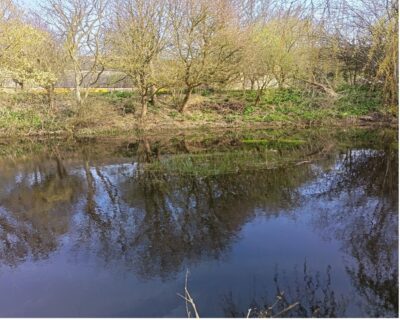
From New Pond, we went on to Foxhole Pond. I visited this when I followed the path down to the cottages available for rent, but did not know it was actually a dew pond. They are usually quite bare, but this one, despite some restoration in 2023, again by Pete and with much vegetation removed and clay re-puddled, looked very different. More management will be required. Little and often is advised, and in Autumn/Winter.
Two-thirds of Britain’s freshwater plants and animals can be found in ponds. They are not just beneficial to invertebrates and amphibians. Bats are attracted to feed on the abundant insects, as are birds who also drink and feed on seeds. I asked if it would be possible to dip in Foxhole Pond too to compare the number and diversity of species but Becca explained that with only one net, there was the potential transfer of detrimental organisms from one site to another. Thinking about how quickly something like duckweed spreads, this makes sense.
From Foxhole Pond, the return to the Visitor Centre followed the main path from the beach. The cottages have no vehicular access, so guests are escorted by the team from SDNP for arrivals and departures. The walk was planned to take two hours but had we visited New Barn Pond too, it would have been longer. There is much more to learn about the history and construction of these ponds and this can be found in David Riviere’s book.
Forthcoming Ranger Guided walks are usually free, displayed on notice boards at the Visitor Centre and bookable on Eventbrite. I was unable to book for this one, but turned up anyway, as I know from experience that not all who register actually come.
For those who haven’t visited Seven Sisters, you are missing one of the most special places in the country. The car parks are very busy on fine days especially but the bus number 12 from Eastbourne or Brighton runs every ten minutes or so.
Come on down.
Visit South Downs National Park Website for further information.


