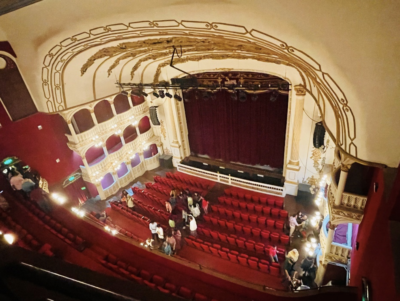
Mumbai is well known for its entertainment industry. Besides hosting the Bollywood film industry, the music & other performing arts that the city nurtures, have flourished under its wings. Due to modern technological advances and virtual access to various entertainment platforms like Netflix and YouTube, these days it’s difficult to feel motivated to move out of one’s comfort bubble to seek entertainment in real time and space. It is a known fact that besides the quality of the content, enjoying a cinema, drama or other performing art, also depends on the quality of the auditoriums too. Most of the Mumbai auditoriums have state-of-the-art hi-tech equipment with a modern ambiance, but one auditorium in South Mumbai, due to its vintage charm, stands out like a jewel in a crown. This unique auditorium located near Girgaon Chowpatty, is the ‘Royal Opera House’ that has an early 20th century old world charm vibe, amidst a 21st century-based bustling ‘maximum city’! The moment one enters the auditorium one feels like being teleported in the colonial era, where art and entertainment were nurtured under the patronage of the then elites of India and the British Raj.
The conceptualization & building of the Opera House started in 1908. It was the brainchild of a passionate Anglo-American actor & theatre manager- Maurice Bandmann & a Indian Parsi coal businessman- Jehangir Framji Karaka. Bandmann was born in New York but studied the art, craft of dramatics and management of theatre in England. He travelled the world with his troupe and become famous mostly in the East, especially India. He used to perform in Calcutta (now Kolkata) and Bombay (now Mumbai). The Opera House was re-christened as ‘The Royal Opera House’ after King George V inaugurated it in 1911! The actual operations of the theatre started in the year 1916. Initially Opera music would be featured at the theatre, then classic dramas were performed and finally in its most struggling years (before it temporarily shut down) it screened cinema too. In 1952, His Highness Maharaja Vikramsingh’ji of the Royal family of Gondal (Gujrat, India) acquired the theatre and later, in 1993, due to deteriorating infra-structure, the theatre shut down. In 2010, the current descendant of The Maharaja of Gondal, His Highness Jyotendrasinh’ji commissioned the restoration of The Royal Opera House. Finally, exactly in it’s centenary year, in 2016, the Royal Opera House re-opened its curtains to its patrons, thus passing its legacy of entertaining the audience in the modern world.
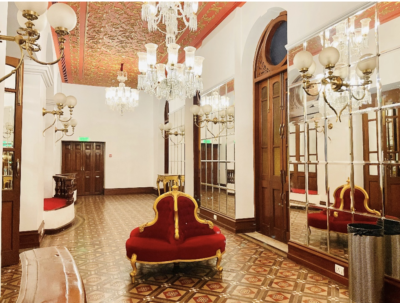
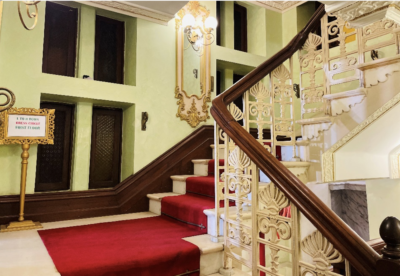
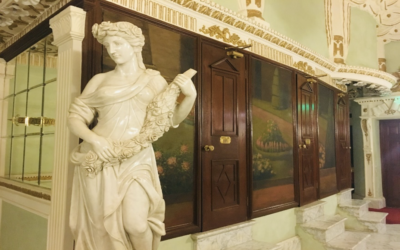
The colonial buildings in Mumbai have a personality of its own. The Royal Opera House is not an exception to this fact. As one climbs the staircase, one notices that the Grand Balcony has ornate designs with vintage lamps and mirrors. With all the artifacts around, one feels the vibe of what it must have been in the bygone era, when the British, the Indian royal families and the elites would feel during their visit at the theatre. The baroque style architecture of the Royal Opera House radiates an oriental vibe, as one admires the magnificent regal chandeliers, proscenium stage and the royal boxes that grace the premise. Once known to be the finest theatre of the East, today it is India’s only surviving Opera House.
The view from the topmost level of the auditorium is mesmerizing as one gets to see the 575-seater hall’s all 3 levels- Royal Stalls, Dress Circle and Grand Balcony. The stage curtain has a unique royal badge positioned at the centre. It is the iconic badge carries the official logo of The Royal family of Gondal. The Royal Opera House is a fusion of heritage and modern themes. The theatre has been awarded with ‘UNESCO Asia pacific Award’ for cultural heritage conservation, which is yet another feather of pride in Mumbai’s cultural cap!
It’s a known fact that most of the past Kings and Queens of India were patrons of art. It’s nice to know that the Maharajas of Gondal have always been sensitive about forwarding the legacy of art which continues even in the modern times. This certainly has set an example in front of the financially rich and powerful citizens of the world, to use their money and power in the right place. Such gestures just don’t restore a heritage premise, but it adds cultural warmth to an otherwise cold commercial vibe of a megalopolis like Mumbai!
Photos Courtesy: Shraddha. C. Sankulkar


