By Albert Fenech
Heritage Malta was founded in 2002 to replace the Museums Department and was originally entrusted with the management of the country’s museums, sites and collections. In 2005 it was made responsible as the national agency to safeguard, conserve and maintain every conservation site.
Now 20 years later, it has performed impressively assiduous work in creating far greater awareness among a population that unfortunately in its majority was largely indifferent to heritage as being merely “a part of history” that has now passed. It has taken on some enormous projects and has been highly successful in its endeavours.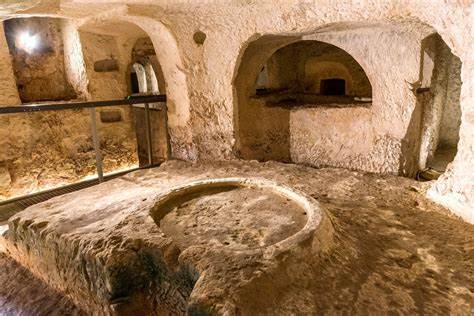
Malta and Gozo are a honeycomb of mysterious caves and caverns, lengthy underground tunnels that submerge below sea level and stretch into the Central Mediterranean. Mysterious cart tracks on land have never been scientifically explained, again causing extravagant ‘explanations’ and speculations of whether they were forms of Stone Age vehicle carriages, or maybe material transporters, or whatever purpose they served.
Among a swirl of various themes and explanations about the role of the islands down through history there is the most popular and bizarre theory that the continent Atlantis surrounded Malta which was its centre and messages were relayed to the ‘Malta Station’ from outer space and then relayed by Malta throughout the continent. Stone tablet letter carvings dating back to Before the Birth of Christ were certified as being identical to stone tablets found in some parts of the United States!
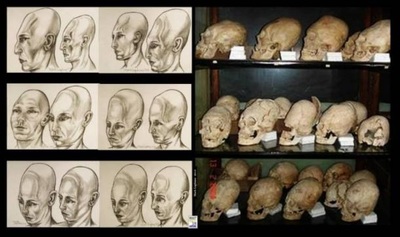
The development of craniums and facial features has always been related to Malta’s history and development.
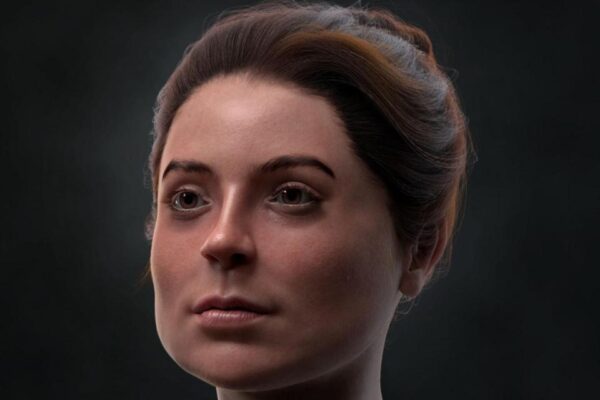
A skeleton discovered in the St Paul’s Catacombs at Rabat in August of 2013 provided a great new insight. It is estimated this dated back to between the 4th Century BC and the 2nd Century AD in a shaft-and-chamber room. A facial reconstruction of the bones of the skull estimated the bones belonged to a woman aged between 18 and 24.
A Heritage Malta statement said “The combination of this biological profile and the conservation of the skull ultimately resulted in sufficient information for specialists to create a facial reconstruction, giving a face to our past.”
The tomb where the skeleton was found was surrounded by a remarkable assemblage of items indicating the female’s status during her lifetime.
However, the real impetus of mystery took place in 1910 when workmen in the Tarxien area were digging residential water wells and burst through the roof of a vast underground chamber that turned out to be an enormous catacomb burial chamber. It was named the Hal Saflieni Hypogeum and further excavations and studies were placed in the hands of medical doctor and archaeological historian Sir Themistocles Zammit who drew up a preliminary report in the same year.
Zammit recorded finding skeletal fragments and the remains of some ten skulls which he measured, at a time when there was an ongoing international debate about the linking of different sized skulls to different ethnicities. Basically, there are three different types of Earth skulls and Zammit reported that those found were of the long-headed type.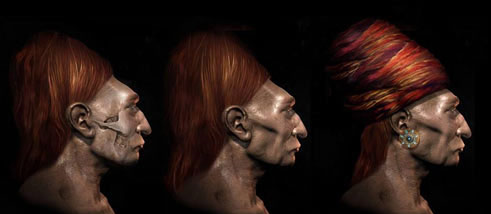
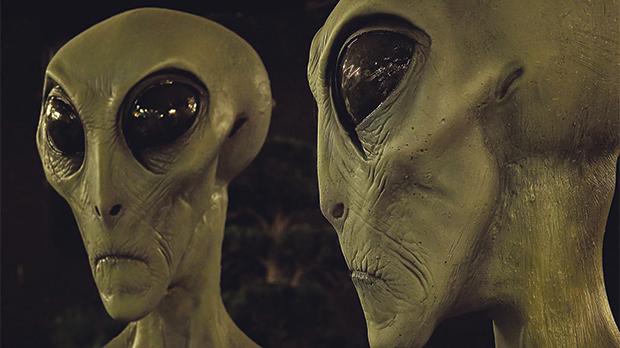
From that point onwards speculation began to run rife, pointing out these skulls did not relate to current Maltese skull shapes and were therefore totally alien skulls. Speculation grew even wilder, claiming the length of the skulls was hitherto unknown on Planet Earth and therefore the only possible conclusion had to be their origins were not Planet Earth but some other planet.
Some linked the skulls to “snake” or “serpent” priests as depicted in skull paintings and inscriptions found in the Egyptian Pyramids.
To fuel speculation further, the skulls were put on display in Malta’s National Museum of Archaeology but suddenly withdrawn from public display in 1980s, a move interpreted to mean the museum was trying to “cover up” the evidence so as not to cause further public alarm at a time when UFO ‘sightings’ were becoming popular.
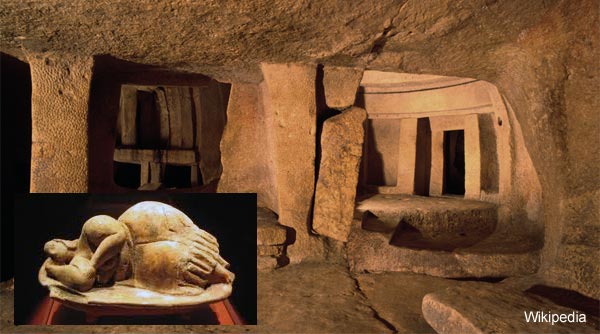
The reason forwarded by the museum was that they were simply long skulls and not ‘elongated’ skulls and were therefore not special, over and above, anybody wishing to carry out scientific studies could apply to the authorities to be given access to them.
Moving on 40 or so years to today, speculation has dwindled and those who view the skulls confirm they are nothing more than long skulls and therefore conform to the three basic Earth skull shapes.
As if this was not enough to be getting on with, in 1940 National Geographic magazine reported that some years earlier a group of schoolchildren visiting the Hypogeum and accompanied by a teacher disappeared and were never seen again.
However, National Geographic also reported that for many weeks after their disappearance, ‘wailing and screaming’ sounds could be heard around the Hypogeum vicinity.
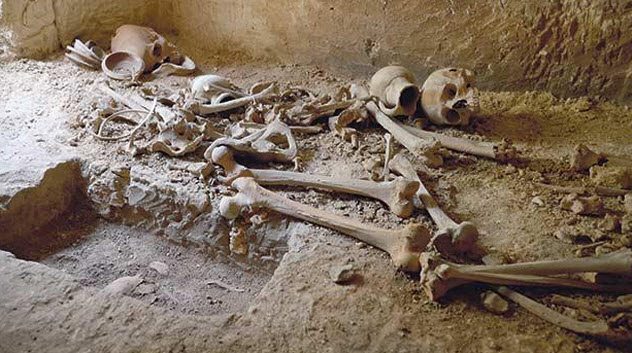
When asked about this ‘myth’ Heritage Malta’s Senior Curator of Prehistoric Sites Katya Stroud explained that a similar incident also surrounded the St Paul’s Catacombs at Rabat and such “happenings” were ploys invented by the authorities to keep curious people – especially children – away from the sites so as to avoid dangerous repercussions as well as having people tramp around a precious site..
Sir Themi’s report also led to a further source of speculation. His investigations had concluded that from the skeletal fragments found, as many as 7,000 people may have been buried in the Hypogeum based on his having found 100 skeletons in a particularly small area. Taken overall, this could mean 7,000 burials over the years.
As during the Stone Age and Iron Age the populations of Malta and Gozo were minimal, this was interpreted to mean that people from “other sources” could also have been buried there, and linked to the ‘elongated skulls’, this could surely lead to only one thing – alien skulls.
And there matters stand – myths or mysteries? Malta and Gozo abound with them!
ALBERT FENECH
salina46af@gmail.com
ALBERT FENECH
MALTESE SAYING
“Listen to everything but only believe as you feel and judge”
With all the fake news swirling around the world today, solid words of advice.


