Relax and enjoy the fragrance of Malta’s flora and fauna environment.
Think about it – what are gardens for? Are they for growing small quantities of crops and fruits to save spending money on having to purchase them? Are they a small patch to rest and relax in for your own privacy? Are they just an open space within the active humdrum of daily life?
Malta and Gozo were once islands covered with indigenous woodland. However, the woods shrank and shrank as trees were cut down for the building and repair of galleons with the Knights of St John establishing the very first Malta dockyard.
Initially gardens were not part of Maltese houses. Most were equipped with a yard endowed with a few potted plants and to provide essential water wells. Gardens were provided by the authorities – more for their own personal embellishment and enjoyment and public entry or encroachment was very highly restricted.
The gardens established were large and luxurious and served a purpose, mostly for their architects, the Knights of the Order of St John of Jerusalem during their 300 years of occupation in Malta and Gozo.
Buskett Gardens
This was one of the first gardens established and by far one of the largest woodland areas in Malta because by then these were/are far and few between, but this one is located in the fertile Luq Valley near Rabat, and west of Siggiewi.
The locality was noted in post-Roman times, a time when sexual celebrations prevailed in order to honour various Gods. When Christianity really took root, the pagan customs were replaced. It became the seat-locality to celebrate the feast of St Peter and St Paul on 29th June.
In June 1557, the then Grandmaster Claude de la Sengle (who gave his name to the town of Senglea on the northern side of Valletta’s Grand Harbour), was taken seriously ill and retired to the valley for peace and quiet. He passed away two months later.
In 1588 the then Grandmaster Hughes de Verdalle decided this was the ideal place for a cool inland palace summer residence and he had constructed Verdala Palace overlooking the valley and established The Boschetto (garden in Italian) as his recreation and hunting ground.
Today it is the official residence of the President of Malta.
The Buskett Garden has broadleaved woodland that is deciduous as well as coniferous trees, together with a number of different trees many of which are fruit bearing and down through the centuries this has remained as one of the greenest areas in Malta.
This is best toured in spring but provides welcome shade during summer.
One occasion Buskett has always remained famous for is the eve celebrations of the feast of St Peter and St Paul on 29th June when catering facilities are privately installed to prepare famous fried rabbit or rabbit stews as well as national competitions for the best vegetables and fruits.
Although not used nowadays, over the last 200 years during marriage ceremonies the groom had to vow to take his bride to the Buskett celebrations of Mnarja (Illumination) on the eve of St Peter and St Paul and when all the roads and lanes are decked with fire torches!
San Anton Gardens
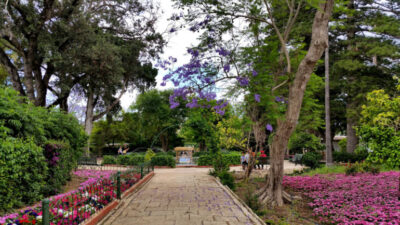
This lies within the grounds of another Presidential Palace in the centre of Malta between Balzan and Attard and was naturally another feat of the Knights, built by Grandmaster Antoine de Paule in the 16th Century with the palace and garden used as another of his summer residences.
Today the Palace is the official residence of the President of Malta and partner.
In 1882 it was opened to the general public and revealed it to be one of the most beautiful gardens in Malta with a large variety of trees and flowers.
The garden is criss-crossed by many pathways for it to be totally visited and enable a view of fountains, ponds and many plants of flowers such as roses and Bougainvillea as well as Norfolk and Araucaria trees and many others from all over the world, some being over 300 years old.
What did it mean to the community at the time? Poverty was rampant, holidays unknown except for Public Holiday occasions and entertainment was highly limited except for enjoying the pleasures of sea and sun in summer.
On entry there is a magnificent fountain and a number of ponds containing sweet water fish, ducks, swans and turtles. Later, this was expanded to include beautiful peacocks, birds and a number of mammals such as small monkeys and rabbits.
San Anton is definitely not to be missed by foreign visitors and is still a great attraction to the local community.
The Upper Barrakka Gardens – Valletta
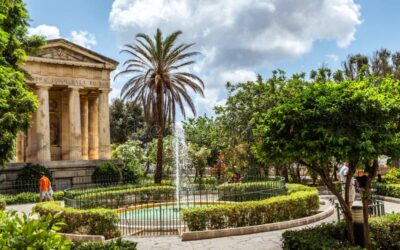
Nowadays these are the most frequented gardens throughout the islands and have been extensively mentioned in my previous articles. Their main aspect is a breathtaking view across the whole of the Valletta Grand Harbour but also many features of flora and fauna as well as historic statues and now a venue for many historic commemorations.
The Argotti Botanical Gardens – Floriana
Over the last five years these have been extensively refurbished, just a stone’s throw from Valletta and containing many species of flowers and trees as well as commemorative statues and plaques and include views of Malta’s other main harbour, Marsamxett Harbour and Floriana’s fortifications.
There are many benches just to sit on and relax.
Sa Maison Garden – Floriana
Seeking peace and quiet in an unusual garden set on several levels and with a look-out Gardjola (look-out point) over the Marsamxett Harbour for the early detection of marine enemy invasions – then this is the ideal garden.
With a number of different British military regiments having occupied barracks in nearby Floriana, many regiment insignias are carved on the garden rocks as well as interesting personal anecdotes.
The Independence Garden – Sliema
Of all the gardens mentioned here this is the newest and knows its establishment shortly after Independence Day on 21st September, 1964.
The whole of my family – including myself – are born and bred in the relatively new town area of Sliema and a major part has a seafront with many plush residential homes looking directly on the blue Mediterranean Sea.
However, the rocks for many, many years were left in an abandoned space and targets for rubbish dumps. The Government of the day decided these rocks should be used significantly and in a sense of commemoration.
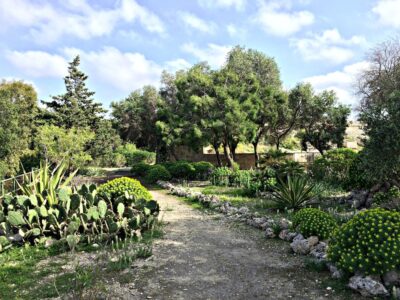
It does not contain the flora and fauna of others gardens nor their history, statues and plaques but it represents a wonderful opportunity to sit on a bench in the Mediterranean sun overlooking the sparkling blue sea.
Villa Bologna – Attard
Built in the 18th Century, the villa and garden are replete with history as well as a number of splendid fountains.
A great number of weddings have been held there as an elegant background for the wedding reception.
In addition, the garden is well-known for its fresh organic vegetable produce and a Veg Box is held every Tuesday, Friday or Saturday for the sale of the products grown there.
Palazzo Parisio – Naxxar
This Palace is situated in the centre of Naxxar which was once a small village but like many other villages in Malta and Gozo have over the years expanded and are more like towns.
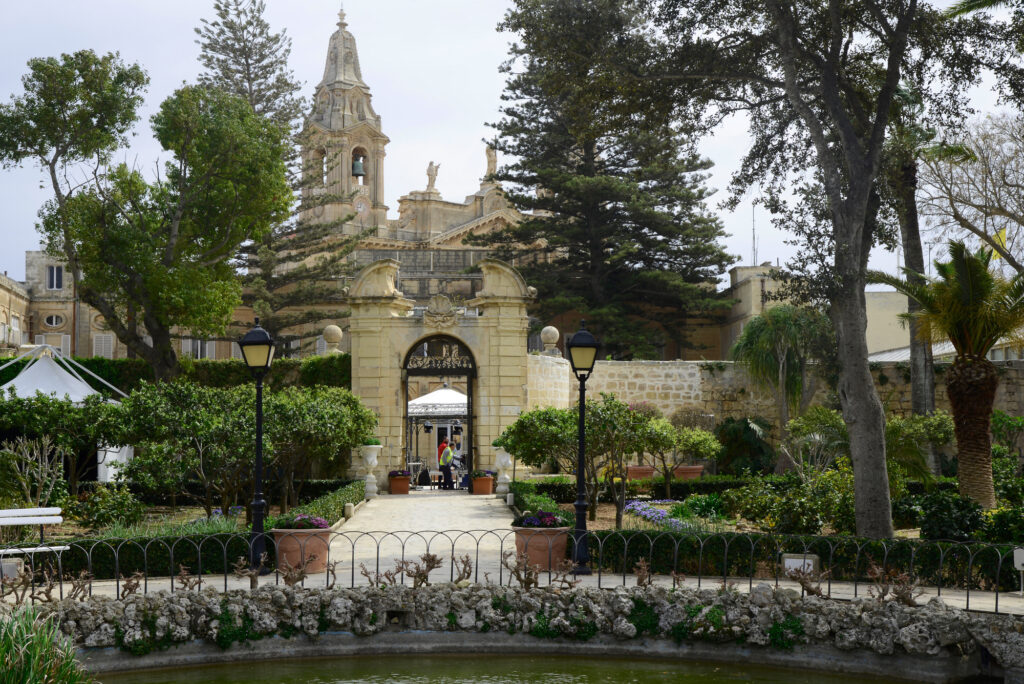
The building is a beautiful example of Baroque architecture in an Italian symmetry and is one of the very few privately owned but always accessible gardens.
It is also a venue for elegant weddings and has a wonderful restaurant for delicious lunches and dinners.
The garden is one of a landscape of enchanting trees, shrubs and flowering plants surrounding an enchanting pond and peaceful in the general tranquility of Naxxar.
Historic Garden (The Garden of Rest) – Floriana
This garden has a most unusual history because of a number of elaborate tombstones spread about it, many looking more like monuments – but mainly for other reasons as a contrast in Malta and Gozo.
It was originally a Protestant cemetery, close to Floriana which, as explained above, housed the barracks for many British regiments.
However, it also contains the grave and tombstone of one of Malta’s greatest citizens, Fr Mikiel Anton Vassalli, who is regarded as “the father” of the Maltese language, having compiled the first dictionary and having a leading part in the ejection of Napoleon and the French.
Later, he fell out with the Roman Catholic Church and when he died in 1829 was refused burial in a Roman Catholic cemetery. The only other alternative was to bury him in this cemetery and there he rests today. As befitting, the garden has a restful ambiance and a small museum.
Chinese Garden of Serenity – Santa Lucija
Again, like the Sliema garden, this is one of the baby gardens and has a recent historical background. In the early 1970s, the then Maltese Prime Minister Dominic Mintoff astounded the world and became the first European Leader to pay an official visit to Communist China.
This resulted in various Chinese industries established in Malta but also their sponsorship of this commemorative Chinese garden and architecture and contains four carefully laid out gardens meant to invoke contemplation.
ALBERT FENECH


