A gin and tonic sipped with ice and lemon in the sunshine is a part of the English summer. Throughout London and the south east, there are now over 40 gin distilleries.
One of these is The Maidstone Distillery in the historic Market Buildings. Whilst not on the same site where George Bishop began distilling in 1785, it is only 200 metres from the original on Bank Street. Recently I was treated to a Gin Experience there by my daughter, who lives in Maidstone.
On this occasion, we were the only visitors which gave us the chance to speak to owner and founder Darren Graves who, together with his wife Samantha, is obviously passionate about the products they produce. The Experience can accommodate 20 guests so we were able to have Bren’s, our host, full attention.
He gave us an informative history on how gin came to be widely consumed in England and why brandy and for lower classes beer, were usurped by the Dutch spirit. When William of Orange, a Protestant, became king after defeating Catholic James II, he decided to heavily tax French brandy as a penalty to France – a catholic country – and his enemy Louis XIV. Not only this but he abolished all tax on gin, the original juniper-flavoured Genever, and there were no licensing restrictions at all.
This meant anyone, anywhere could actually distil their own gin. The result was the Gin Craze of the 1700s. In London, more gin was drunk than water and the total deregulation led to addiction, crime and poverty. Often it was cut with turpentine and even sulphuric acid! The well-known engraving by Hogarth of ‘Gin Lane’ shows the horrors of the breakdown in order. In 1751 the Gin Act finally restricted distilleries, required licensing and enforced tighter controls.
George Bishop was a young man during this period working in a distillery in Holland, where he learned the art of gin production. He aimed to set up a distillery in Maidstone, his home town, and was determined to produce a spirit of extremely high quality. Eventually, his lobbying of Parliament – arguing that his spirit would be a superior British product and so would prevent smuggling – led to an Act of Parliament decreeing he could distil Maidstone Genever (gin) and be exempt from certain duties,
Bishop’s new distillery, built in 1785, dominated Maidstone and thus Maidstone gained the reputation of producing one of the finest gins in Europe. One of the large pictures on the wall shows a caricature, by James Gilray, of Napoleon and Josephine enjoying the ‘spoils’ after his anticipated conquest of England. Alongside important buildings like the Bank of England and the Tower of London are empty bottles – one of which has the label ‘Maidstone.’ Perhaps even Napoleon enjoyed Bishop’s gin.
Such was the demand that a production of 5000 gallons a week was necessary to keep up with it. In 1818, 25 years after Bishop’s death, the distillery, which had been passed to relatives, closed.
In the 1850s, a new Maidstone distillery was set up by Thomas Grant to replicate the original spirit. Also produced was Morello Cherry Brandy. This made the most of the crop in Kent, ‘the garden of England’, and was much favoured by Queen Victoria. In 1982 production finally ceased.
Darren and Samantha Graves opened the Maidstone Distillery in 2020, resurrecting the spirit of George Bishop with their original product fittingly named after him. This was the first of the four spirits we tasted.
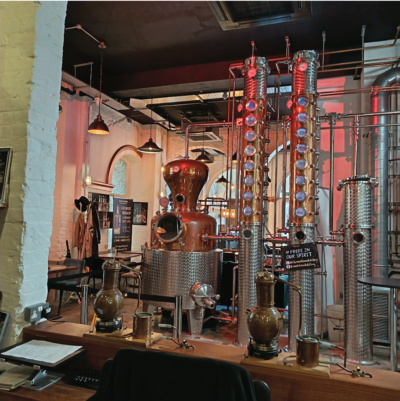
Before the tasting began, Bren explained about the equipment and the processes. The various products require the grain to be treated in different ways – each contributing to the various flavours and variance in strength. Part of the process produces methanol which, of course, is not to be consumed but during Covid, when the distillery was in its infancy, the waste product was cleverly used to make hand sanitiser. The impressive copper still was commissioned from Canada. There are several specialist columns and basket attachments designed for maximum flavour and ‘vapour infusions.’
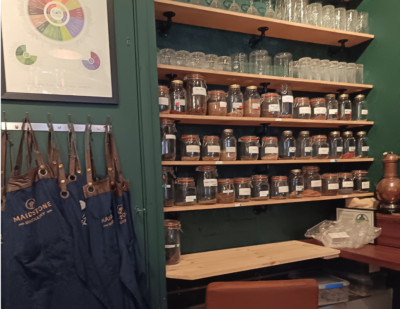
All around the walls are botanical ingredients which combine to create unique flavours. Bren handed us some to see if we could determine what they were. Dried orange peel was quite easy but corn mint is something we had never heard of. He explained that this is collected at Ranscombe Farm in partnership with the Charity Plantlife and is an ingredient in their Ranscombe Wild Small Batch gin.
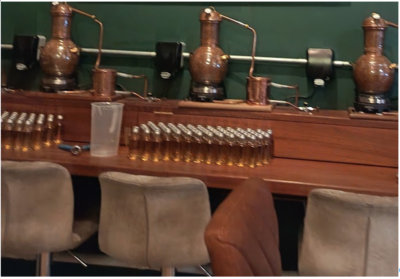
We began the sampling with the George Bishop. The first sip was neat, but at 43%, tonic was most definitely needed. Such is the flavour that the tonic did not distract from it. This is the distillery’s flagship gin and there is also a Gin Essence designed for mixing low alcohol drinks at less than 1.2 ABV
Next came the Ranscombe Wild Small Batch, produced with myriad botanicals, including the corn mint. To further link it to conservation 2.5% of profits support wild plant preservation. This is not quite as strong as the George Bishop and has a distinct aroma and taste which evokes the countryside.
The third sample, each of good measures, was Kipsi Rose Pink Gin. Apparently, it was Henry VIII who was so impressed by the abundance of soft fruits in the county that he named Kent ‘the garden of England.’ The name Kipsi comes from the wicker baskets used for harvesting. The flavours of Kentish Morello and Dark Cherries, along with strawberries and raspberries create the flavour and colour. I thought this would be perfect for sunny summer days.
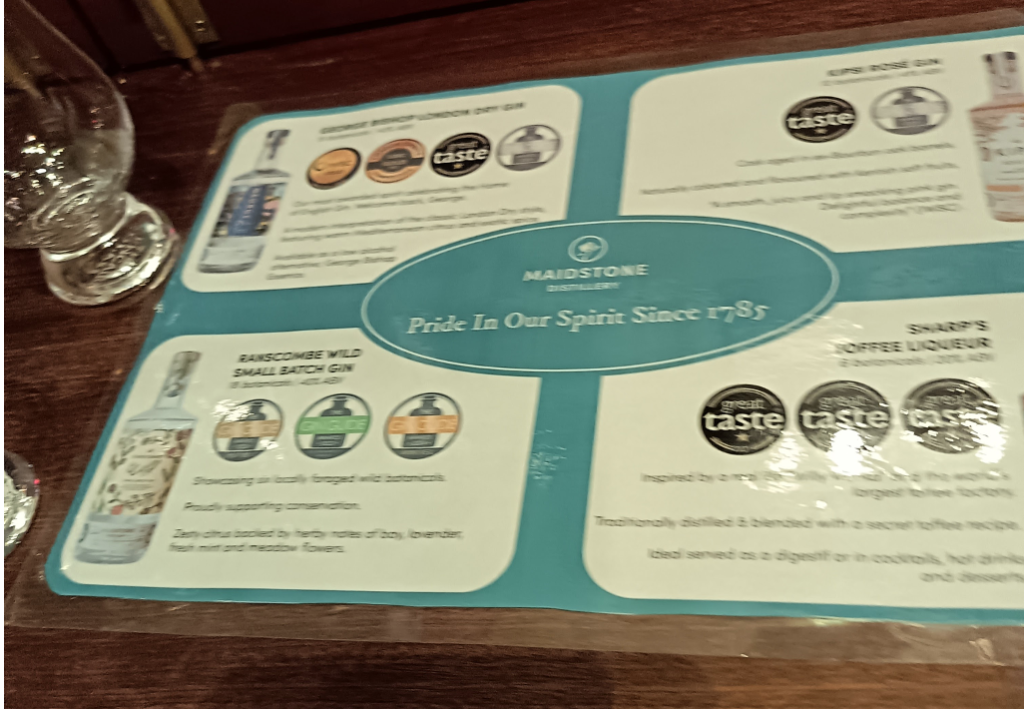
Finally, we tried the Sharps Toffee liqueur which does not require the addition of tonic and replicates the taste of toffee perfectly in alcoholic form. Edward Sharp was one of the largest toffee manufacturers in the world and his business began in 1878 in Maidstone. The factory closed in 2000, by then owned by Cadbury. Maidstone Distillery’s Toffee liqueur is an acknowledgement of another influential Maidstone business.
The labels on all the products are not only designed there but also applied by hand. Labels are also produced for other brands as well as bespoke spirits. Behind the bar I noticed large round bottles with taps containing various liquids. They are called ‘carboys’. They hold the various spirits as it is possible to bring back empty bottles, complete with corks, to have them refilled. This saves £5 on the 70cl price and cuts down on the need to recycle.
We spent a very pleasant and informative afternoon at The Maidstone distillery and my daughter will definitely visit again – this time remembering to return empty bottles for refilling
Purchase online direct from the Maidstone Distillery website, https://www.themaidstonedistillery.com as well as via Tesco and the Tipple cellar. Experiences are bookable through the website.
The best place to buy, and of course taste, is at the distillery itself at 5 Market buildings ME14 1HP


