
Oscar Wilde once remarked that he put all his genius into his life and only his talent into his works. That observation forms the beating heart of The Importance of Being Oscar, Micheál Mac Liammóir’s celebrated one-man play, currently touring the UK and performed with remarkable skill by Alastair Whatley. I attended the matinee at Eastbourne’s Devonshire Park Theatre, its dated elegance being the perfect setting for this play.
Directed by Michael Fentiman, this acclaimed production traces Wilde’s extraordinary journey from celebrated wit, playwright and social phenomenon to disgraced prisoner and exiled outcast. Told largely through Wilde’s own words and writings, the play blends biography, literary excerpts and social commentary into a compelling theatrical portrait of one of Britain’s most fascinating literary figures.
The challenge of any one-man show is sustaining audience engagement for almost two hours, yet Whatley achieves this with apparent ease on a minimalist set, his only prop being a lapel flower. His performance is a masterclass in restraint, versatility and emotional intelligence. Rather than attempting a simple impersonation, he inhabits Wilde’s spirit, moving seamlessly between narrator, biographer, social observer and the various characters who populated Wilde’s life and imagination.
Wilde’s celebrated epigrams sparkle throughout the play, drawing frequent laughter from the audience, yet the wit is never allowed to become mere stand-up comedy. Beneath every polished bon mot lies an undercurrent of vulnerability, particularly as the narrative darkens towards Wilde’s catastrophic downfall.
The first half revels in Wilde’s meteoric rise. We encounter the flamboyant aesthete dazzling London society, conquering the literary world and delighting audiences with works such as The Importance of Being Earnest and An Ideal Husband. The production captures the intoxicating glamour of Wilde’s success while highlighting the confidence and audacity that made him both adored and resented.
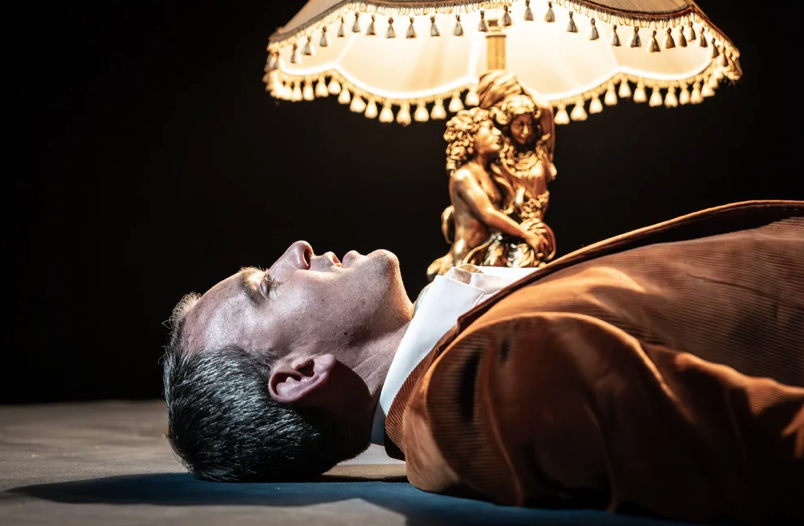
However, in the second half the atmosphere changes dramatically as Wilde’s ill-fated relationship with Lord Alfred Douglas leads to public scandal, criminal prosecution and imprisonment. Whatley handles these darker passages with sensitivity and dignity. The suffering of Reading Gaol, the loss of reputation and the crushing loneliness of exile are conveyed with quiet power rather than melodrama.
Fentiman’s direction wisely avoids unnecessary theatrical embellishment. The elegantly simple staging allowing Wilde’s words and Whatley’s performance to remain the focal point. Carefully judged lighting and sound design avoid distraction, while the sparse set evokes both a prison cell and a theatrical stage, reflecting the duality of Wilde’s public and private lives.
The persecution Wilde endured is hard to accept today yet it’s the exploration of prejudice, public morality and the price paid by those who challenge societal conventions that resonates. And have we really moved on? We are reminded how quickly fame can turn to condemnation and how fragile public acceptance can be. We see this even today as the media selects who is to be the next victim of its “build ’em up to bring ’em down” culture.
The script itself remains remarkably fresh more than sixty years after Mac Liammóir first created it. By interweaving passages from Wilde’s plays, poetry, letters and prose, it paints a richly textured portrait that introduces newcomers to Wilde while offering fresh insights for admirers already familiar with his work.
By the final moments, Whatley has accomplished something rare. He has not merely performed Oscar Wilde; he has resurrected him. The audience leaves feeling they have spent an evening in the company of the man himself — witty, brilliant, flawed, courageous and profoundly human.
The Importance of Being Oscar is an intelligent, moving and thoroughly entertaining piece of theatre. Anchored by an exceptional central performance, it stands as both a celebration of Wilde’s literary genius and a poignant reminder of the personal tragedy behind the legend. A captivating evening that lingers long after the curtain call.
The play is touring through to August 22. Check for locations and tickets at www.oscarplay.co.uk


