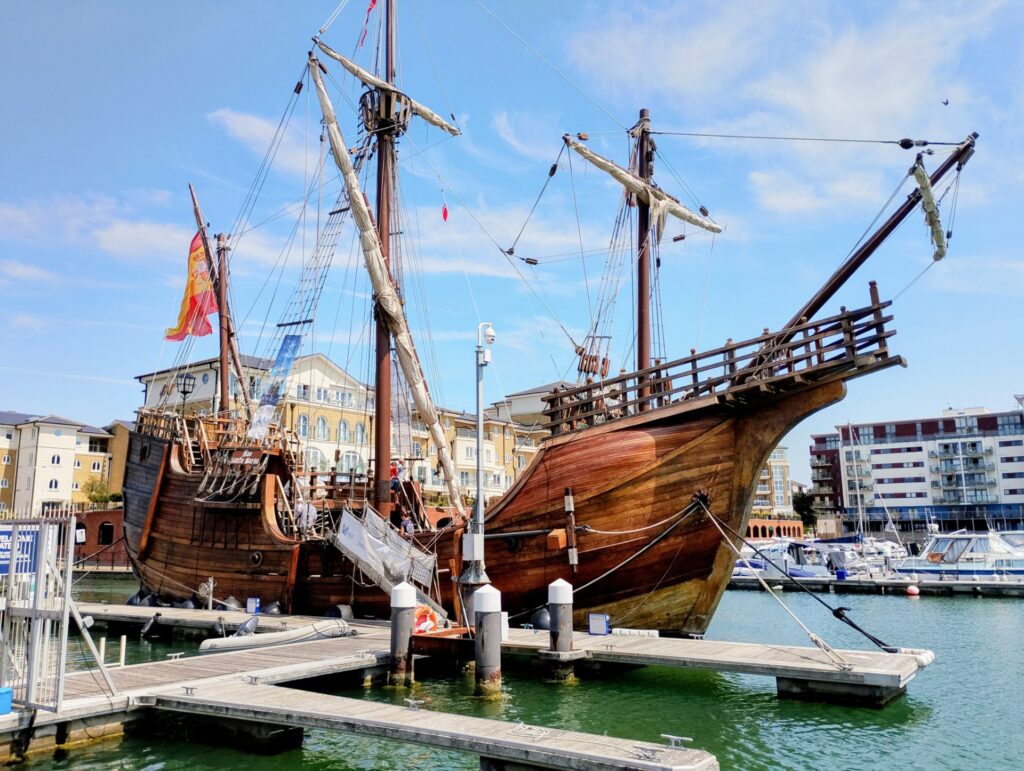
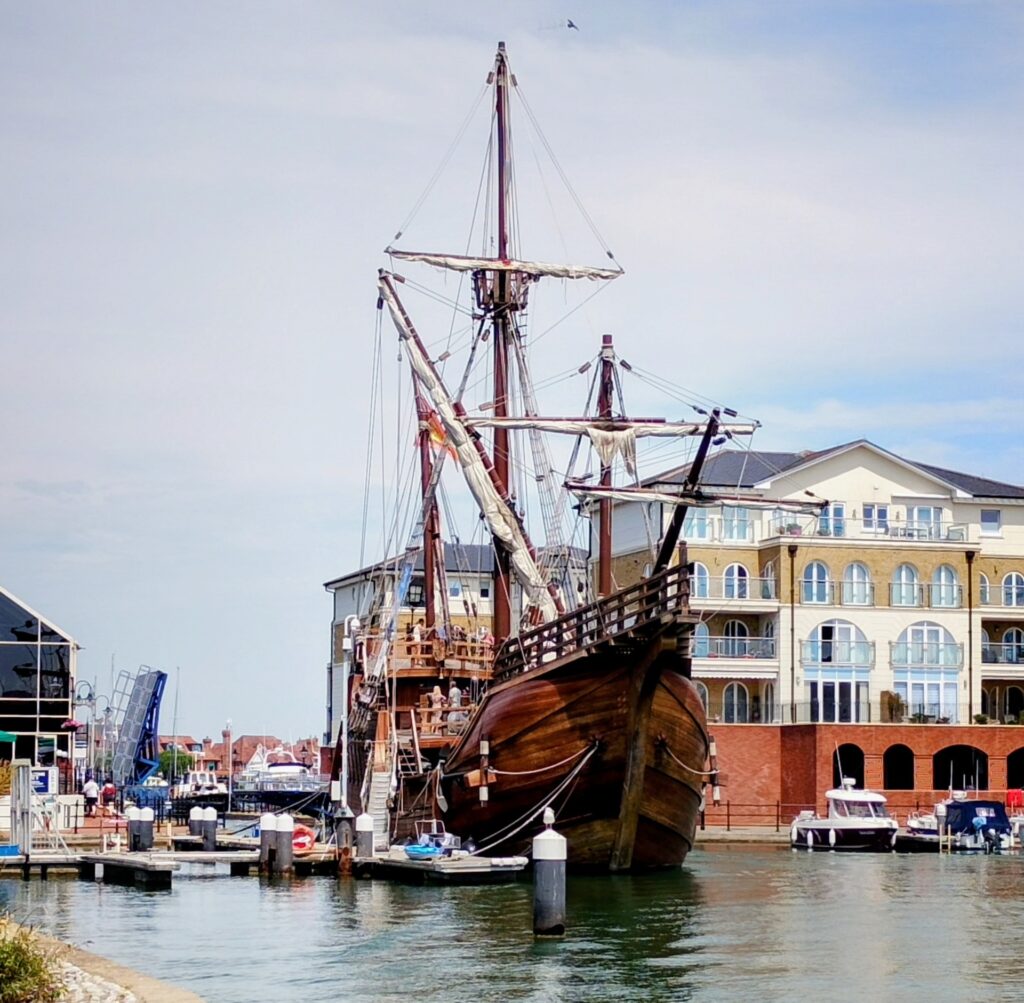
The Nao Santa Maria, pictured, is a replica of the boat in which Christopher Columbus sailed across the Atlantic Ocean in 1492. The boat was on a visit to Eastbourne’s Sovereign Harbour before sailing on to Shoreham on 29 June.
Launched in 2018, it took fourteen months to construct, using iroko and pine woods. Iroko is an African hardwood, initially yellow but darkens to a richer copper-brown with time. Iroko is extremely durable and requires no regular treatment. The boat weighs two-hundred tonnes and has 2.5 miles of rope rigging to service its three masts. The main masts are entire iroko tree trunks. An engine is fitted for manoeuvrability in port but sails are used on open sea voyages by an eighteen-man crew made up mainly of students and volunteers. Columbus’s boat had a shanghaied crew of forty.
A second replica, the Marigalante, built earlier in 1987, sank off the coast of Mexico last year. The original Santa Maria also sank, Christmas Eve 1492, when it ran aground on a reef off the coast of Haiti where the first European settlement was established. Two smaller boats accompanied the Santa Maria, the Pinta and the Nina, and Columbus returned to Spain aboard the Nina. Subsequent voyages landed on the mainland but Columbus did not realise that he had stumbled upon a new continent.
Columbus’s mission was to discover a shorter profitable trade route to Asia. Classroom history lessons tell us he discovered America, but it’s not quite true; in 1492 Columbus came ashore on present day Haiti in the West Indies. Also the notion of ‘discovery’ of the American continent is dubious, archaeological evidence indicates North America had been inhabited for around 20,000 years. Columbus’s voyage, and subsequent voyages, represent little more than the colonization of North America by European settlers. There is incontrovertible evidence Viking traders reached Newfoundland and established a Norse settlement a thousand years before Columbus. Evidence of pre-Columbus Roman and Chinese colonization also exists.
Amerigo Vespucci, Italian explorer and cartographer, was the first to demonstrate the lands reached by Europeans were a separate continent, and not part of Asia, hence the ‘New World’ label. He completed voyages on behalf of Spain and then Portugal between 1497 and 1504. In recognising Vespucci’s accomplishments, mapmaker Martin Waldseemuller named the ‘New World’ America (latinized form of Amerigo). Subsequent cartographers copied the name.
[Photos Author’s Own Copyright]


