P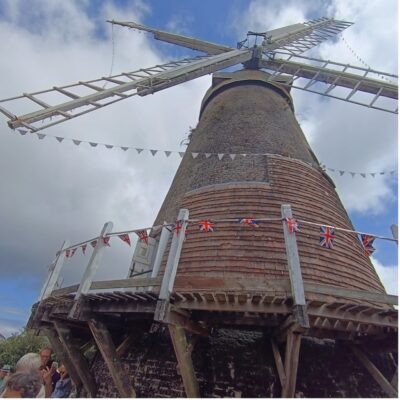
Tucked away just off the main road from Eastbourne and before the Polegate junction, is Polegate Windmill. It has been also known as Willingdon Windmill – the name changes reflecting boundary alterations.
It is the sort of structure that, despite living nearby, or even walking past, is often overlooked. The mill stands surrounded by housing now, but when it was built in 1817, on the site of a much earlier construction, it would have stood alone to catch the wind to turn its sweeps. Apparently, it is only in Kent and Sussex that this word is used. Elsewhere they are, more familiarly, called sails.
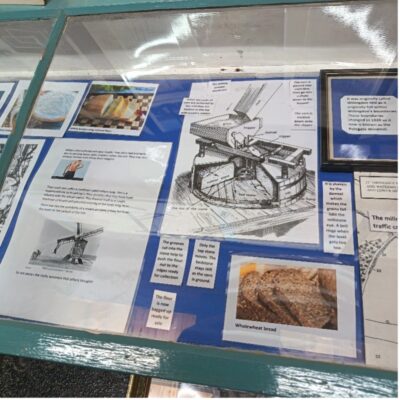
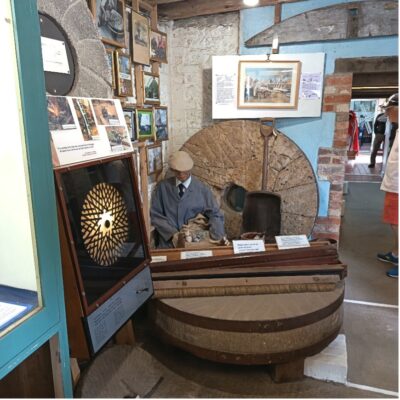
Wind powered the mill until 1943 when an auxiliary engine and later an electric motor took over. It ran until 1965, by which time it no longer ground flour but only feed for livestock. The huge grinding stones, or burrs, were adjusted up and down to determine the texture of the product – how fine it would be. The museum holds a large collection, not only of implements that were used but also documents and photographs showing the history and operation of the mill.
Discovered close to a local school, and now in the museum, is the medieval mill post used to support the earlier structure. Buried deep in the ground, a trestle would have been added to support a weight as heavy as eighteen tons.
Since the closure, there has been patchy conservation and renovation. The Eastbourne and District Preservation Trust was set up in 1965 specifically to buy the mill and endeavour to restore it. In 1967 The Duke of Devonshire officially opened the mill and the Milling Museum opened to the public in May 1968.
Work continued into the 1970s when the sweeps needed replacement as a stock (the main structural log) broke and brought one down. Forward to the 2000s; more work was done in 2004 and 2009. By the time Covid hit, financial support had dwindled and once more the mill suffered from neglect.
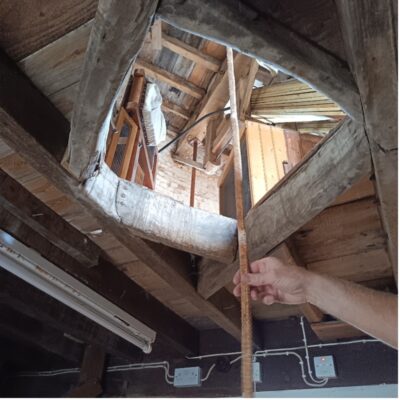
Water ingress and deathwatch beetle infestation took their toll. Now, with a new group of volunteers regularly giving their time, the future of the mill looks brighter. Having seen inside during the Open Day and Fete on 26/7, although not able to go up because of safety reasons, it is clear there is much work to do.
The beams into the walls are rotten so need replacing and the deteriorating limewash must be carefully removed also. Apparently vinegar is good for this but given the size of the area needing stripping, gallons would be required so for now scraping continues. Samples have been sent for analysis to ensure the correct mixture is used for replacement.
The volunteers, now more than a dozen, work on Wednesdays to maintain, protect and update as well as improving the museum. They hope that as a result of a recently commissioned survey, work needed can be broken down into phased manageable chunks.
Standing on the splat, which is the name given to the open grass area outside the mill, and looking up at the sweeps, seeing only the sky and not the modernity around it, it is easy to imagine them turning the giant burr to mill flour to feed the local population.
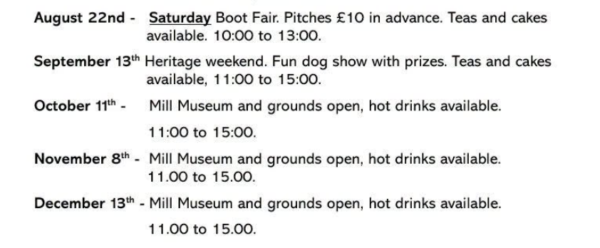
The mill has a room used for education and local groups can use it too so the mill is still part of the community. There is a boot fair on 22nd August and on September 13th it is open as part of the Heritage weekend. See below for dates you can visit during 2026:
This is a very brief introduction to the mill and its history. Much more information, including the ongoing work of the volunteers, can be found on the Facebook page. (20+) Facebook
Here is some Windmill Wisdom I learned from the museum.
- Keep your nose to the grindstone – flour heats while being ground so the miller would literally put his nose close to smell the flour in case it burned.
- Three sheets to the wind – A four-sailed windmill with only three covered in canvas turns off balance so this term became used for drunks.
- Rule of thumb – to test the grinding of the flour, the miller would take a pinch between his thumb and first finger. If it felt too coarse, it would be ground again.


Sounds like a lovely little spot for a quiet afternoon. I’ve always been fascinated by old windmills, it would be great to see one up close.