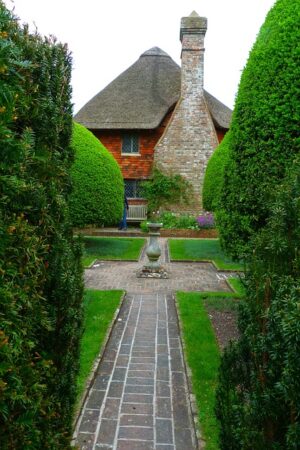
The housing stock of Kent and Sussex is one of its quiet glories. Wealden hall houses, Victorian seaside terraces, Edwardian villas on the commuter lines, weatherboarded cottages in villages the main roads forgot. Living in one is a pleasure. Clearing one out, before a renovation or after a house sale, is a job with its own rules, and the skip on the street outside is where most people meet them for the first time.
Old houses hide heavy secrets
A period property clear-out is not like emptying a 1990s semi. The waste is heavier and stranger: lath and plaster brought down from a ceiling weighs far more than modern plasterboard, Victorian tiles come up with a bed of concrete attached, and a single room can yield a fireplace surround, two rolls of ancient carpet and a water tank nobody remembers installing. The rule of thumb from people who do this often is to estimate the volume, then order one size smaller than instinct suggests and fill it twice if needed, because heavy waste hits a skip's weight limit long before it reaches the rim.
Salvage first, skip second
Before anything goes in the skip, the region's salvage culture deserves a look. Reclaimed Kent peg tiles, old floorboards, panel doors and even good brick have real value, and reclamation yards across the two counties will sometimes collect. What the yards will not take, local selling groups often will. The skip is for what remains: the broken, the rotten and the genuinely unwanted.
What it costs, and the permit question
Prices vary more than people expect between towns, which makes it worth checking locally rather than accepting the first national quote. Comparing skip hire across East Sussex shows a 4-yard skip running from around £198 depending on the postcode, with the equivalent Kent figure starting lower in the Medway towns. Listings on Rent-a-Skip carry the local rates town by town for both counties, which saves ringing round.
The permit is the detail that changes with the county line. A skip on a private driveway needs no permission anywhere. On the public road, East Sussex County Council charges £68 for a 14-day permit across most of the county, while Brighton and Hove runs its own scheme at £89.10 for 28 days with three working days' notice. Over the border, Medway Council charges £73. In the narrow lanes of the older towns, Rye and Lewes being the obvious examples, the practical answer is often a smaller skip that sits within a parking bay, swapped more frequently.
What stays out of the skip
Period homes produce their own contraband. Asbestos, common in garages, outhouses and old floor tiles from mid-century alterations, must never go in a skip and needs a specialist contractor. Old paint tins, gas cylinders from long-dead caravans and anything with a plug generally need the household recycling centre instead. The operator will list the exclusions when the skip is booked; asking up front is cheaper than a contamination charge afterwards.
The reward
There is a particular satisfaction in seeing a period house emptied of a century of accumulation, its rooms suddenly the size the builder intended. The skip leaves, the light comes back, and the house is ready for whatever comes next. The counties have been renovating their old homes for as long as they have been building them; done with a little planning, the clear-out is the easy part.


That’s a really interesting point about the housing stock there – it’s fantastic how much character remains despite the age of these properties.