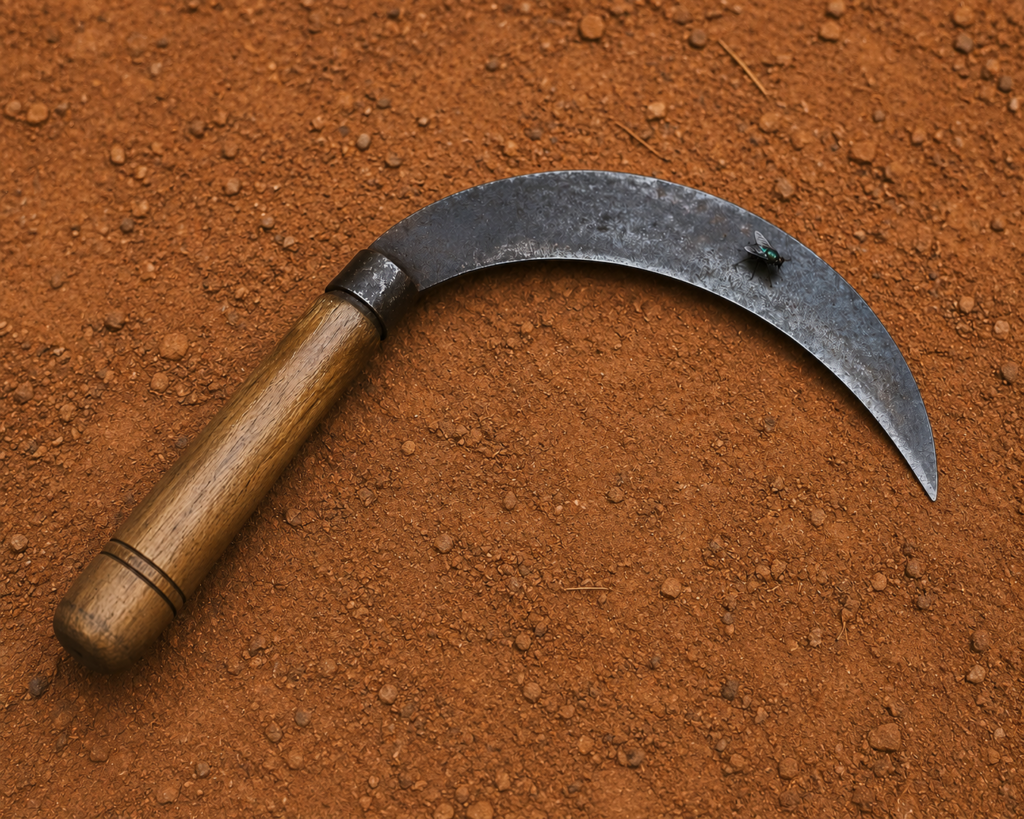
August, 1235, Hunan Province, China. A man’s body is discovered in a rice field hacked to death with multiple stab wounds. The presiding magistrate, Sung Tz’u (1186 – 1249) is sent from Jianyang (present day Nanping) to investigate.
The nature of the cuts indicated a frenzied attack with a sickle as the murder weapon. It was harvest-time and curved sickles were used for cutting rice which led Sung Tz’u to suspect a fellow peasant worker to be the culprit. Each sickle bore the mark of its owner on the handle, but visual examination of the blades showed no sign of blood.
Sung Tz’u assembled all the villagers in the main square where they were required to relinquish their sickles. The sickles were laid on the ground in the sun and Sung Tz’u and the villagers sat and waited.
A few minutes later, despite its clean appearance, a blow fly settled on one sickle, followed by another fly and another. Soon the blade was swarming with flies, attracted by the scent of traces of blood not visible to the naked eye. The other sickle blades did not attract the flies. The murder weapon thus revealed the perpetrator was arrested. He confessed and summarily beheaded. The victim’s family were compensated with the man’s meagre possessions. The motive for the murder remains unknown.
Blow flies (metallic-coloured flies, with common names such as ‘blue bottles’) have the ability to smell blood and carrion from up to one mile away. Song Tz’u’s case was the first recorded use of forensic entomology to solve a murder enquiry.
Sung Tz’u was a physician, medical scientist, anthropologist and magistrate and famed as the founding father of forensic science in China. His publication, Collected Cases of Injustice Rectified, recorded his experiences of examining bodies in criminal investigations and became the bible for coroners, translated into several foreign languages, including English.


