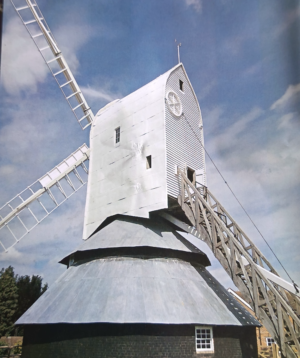
Not far from its better-known neighbour, Herstmonceux Castle, is Windmill Hill Mill.
This mill has existed here since 1814 but much earlier mills stood nearby to make use of the high elevation.
The Windmill Trust was formed in 1996 and to celebrate its thirtieth anniversary, the mill held a number of events. I visited and took the tour on 30th August.
The first thing that struck me was the size. Not really surprising, as it is the second tallest post mill in England after Friston Mill near Aldeburgh in Suffolk – although the difference is only a couple of feet. It is though, the largest by body size. It is called a post mill because the whole structure rotates on a massive oak post.
As the tour, led by volunteer Bob, progressed upwards he explained something of how the mill operated. The sails, or sweeps as they are known in Kent and Sussex, were designed to face the wind to drive the mechanism. When the wind changed direction, the miller would manually rotate the entire mill body on its central post using a tail pole as a giant lever. Instead of this cumbersome pole, there is now an automatic turning device, linked to sensors, that runs on a metal track. This then rotates to turn the mill to face the wind. This large metal circle was the second thing to strike me after the mill’s size and its purpose was the first question I asked.
Being able to access the highest area of the mill, which stands at over 50 feet, is not for anyone uncomfortable with steep steps or heights. At the highest accessible point, movement of the structure can be felt. It is an odd sensation, like being on a slightly pitching boat.
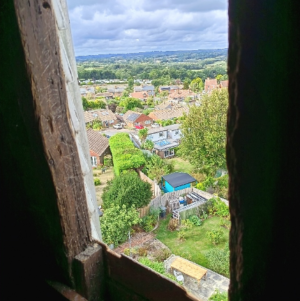
The view from the open window across the Pevensey Levels many years ago allowed colliers to see when coal was coming from Pevensey Bay, so they could collect it with minimal delay.
We were informed the central post, the original from 1814, supports a weight of 33 tons and that the mill boasts the only Sweep Governor in existence. This device was patented in 1873 to allow the sweeps to react to the wind by adjusting shutters. Fifteen revolutions a minute is the optimal speed for milling, so the miller would make adjustments each day to the mechanism to set this.
To fully understand the amount of equipment needed to operate the mill, the complexity of it, how such mechanics evolved and how the whole process works would require much further study. An interesting fact we were told was about the ‘Smutter’. This is a cylinder with a wire mesh or metal screen. Beaters or brushes inside dashed the grain against the mesh to dislodge and destroy the black fungal spores, or smuts, attached to the wheat. This was then blown away leaving the grain clean for milling. These spores, known as Ergo, when eaten cause poisoning resulting in headaches, diarrhoea and even gangrene of the limbs! They can also attack the nervous system causing seizures and hallucinations with an early sign being the sensation of insects crawling under the skin.
Bob drew our attention to the parallels with the witch trials in Salem Massachusetts. Ergo was proposed as the cause for the women’s behaviour thus marking them as witches and resulting in death by burning in 1692. I looked into this further and discovered this link was not suggested until the 1970s and is now disputed as being the main cause but maybe contributory. However, the fact that unclean grain causes very unpleasant effects is not disputed.
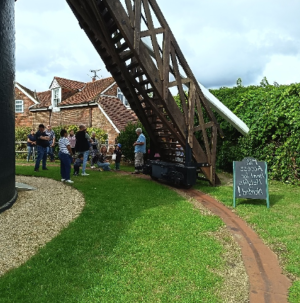
A short distance down from the mill is Windmill Hill Garage. This was once a blacksmith’s forge. In early 1900s the then owner of the mill delivered bread, flour and coal – hopefully in separate carts – and when his horse needed shoeing, he would slap its rump and send it off down to be shod. It would, once reshod, make its way back up to the windmill. The bakery, which is now a private house was adjacent to the mill. A large house called Mount Pleasant, was built close to the mill and the then owner, Edward Beeny ( an ancestor of TV presenter Sarah Beeny) claimed the building literally ‘took the wind out of his sails.’ To remedy this after losing a court case, he raised the entire mill on brick piers to lift the height and catch the wind again.
The mill was also used for communication. Being the highest point meant the sweeps were visible over a long distance. Their position indicated status and events:-
- When in the Celebration position, rising – setting the top sail just before it reaches the vertical peak – they signify joy, such as a birth or wedding.
- When in the Mourning position, descending – stopping the top sail past the peak – they signify death or a funeral.
- The X shape shows the mill is shut down or on an extended break.
- The + shape shows the miller is simply having a rest.
Considering the hard work involved operating the mill, I think he would have deserved one!
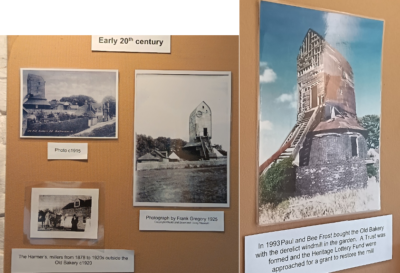
The mill remained wind-driven until 1894 when converted to steam and continued to operate until 1913 when it began to deteriorate. During WW2 is was used as a navigation aid for returning bombers. Gradual decay continued until the trust was set up and work to restore began in earnest in 2003. The detailed assessment carried in 2000 did not provide encouraging results. Rain ingress over the years had rotted the timbers from the top downwards and the condition was found to be worse than first thought. The only course of action was to completely dismantle it.
Fast forward to 2026 and the mill looks impressive indeed. Inside the roundhouse are items, photographs and a video showing the progress made. There are souvenirs to buy and also flour made as it would have been back when the mill supplied the local area. It is all operated by volunteers. The Friends of Windmill Hill Mill carry out fundraising activities from stalls and raffles to barn dances. It is open on Sundays from 2.30 to 5.00 pm from Easter to mid-September (check on the website). Group visits can be arranged with a virtual tour for those who cannot manage the rather daunting steps up.
Check out the website windmillhillwindmill.org or the Facebook page for details of events or to find out more.
Postcode is BN27 4RT
What3 words are upward.rope.processor


