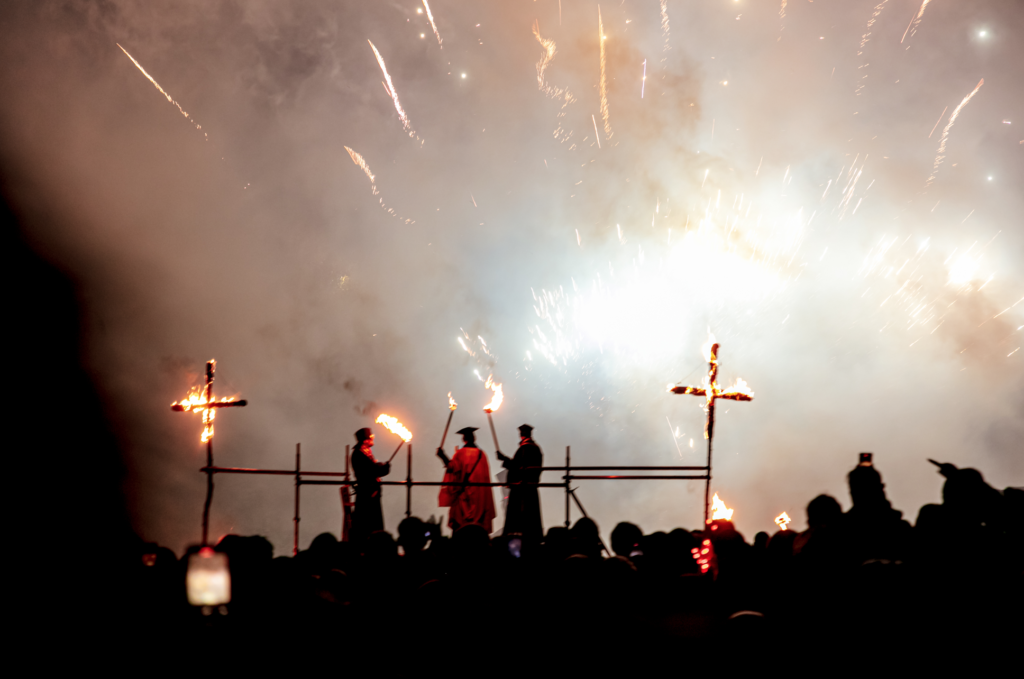
There are few sights quite like a Sussex bonfire procession on a dark autumn evening. The glow of flaming torches, the thud of marching drums, the crackle of fireworks and the sight of elaborately dressed societies making their way through our streets all combine to create something rather different from an ordinary Bonfire Night.
Across Sussex, villages and towns have been keeping this tradition alive for generations. Some celebrations are relatively small community affairs; others, particularly Lewes, have become famous far beyond the county. There is history behind the spectacle, too: religious conflict, local rivalries, political satire, charitable fundraising and a great deal of hard work by volunteers.
And while the Fifth of November is the date most people associate with Bonfire Night, in Sussex the celebrations extend over several weeks. Welcome to our very own bonfire season.
How did the Sussex bonfire tradition begin?
The familiar rhyme, Remember, remember the fifth of November, refers to the Gunpowder Plot of 1605, when Guy Fawkes and his fellow conspirators attempted to blow up the Houses of Parliament and kill King James I. Their plot was discovered, and the failure was subsequently marked by annual thanksgiving observances. Bonfires and fireworks became part of the custom.
In Sussex, however, the tradition acquired a distinctive local character. By the nineteenth century, Bonfire Night could be a rowdy affair, with large fires, fireworks, burning tar barrels and crowds taking over the streets. Groups known as the Bonfire Boys sometimes clashed with the authorities, who were concerned about public disorder and the dangers of uncontrolled fires.
Gradually, organised Bonfire Societies emerged. These groups brought greater structure to the celebrations, developing their own costumes, banners, processions and traditions. They also became involved in charitable fundraising, an important part of the movement that continues today.
Lewes has particularly strong historical associations. Its celebrations commemorate not only the failure of the Gunpowder Plot but also the seventeen Protestant martyrs burned at the stake in the town between 1555 and 1557 during the reign of Queen Mary I. Burning crosses carried in the processions remember those who died for their beliefs. The town’s bonfire tradition is therefore a mixture of national history and a much more painful chapter in Sussex’s own past.
The organised societies familiar today largely developed during the nineteenth century, although some local celebrations are older. One of the most remarkable features of the Sussex tradition is that it has survived interruptions, changing regulations and two world wars. Today, the county’s bonfire season is a living expression of local identity, with societies visiting one another’s events and maintaining friendships across the county.
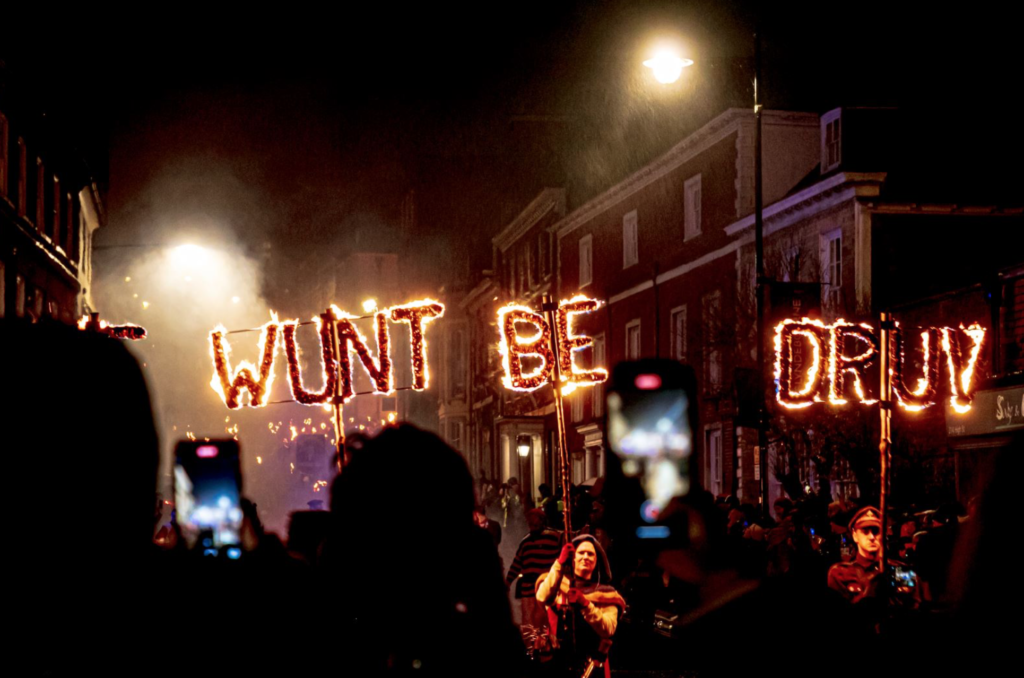
Lewes: probably the best-known bonfire town
Mention Sussex Bonfire Night and most people immediately think of Lewes. The town’s celebrations on 5 November are among the most distinctive in the country, combining torchlit processions, bands, elaborate costumes, historical tableaux, bonfires and fireworks.
The tradition has a long recorded history. A local account records celebrations in 1679, while the familiar organised society movement took shape during the nineteenth century. Lewes Borough and Cliffe are among the oldest societies, with their modern organisational histories generally traced to the 1850s. Other societies followed, each developing its own character and customs.
Rather than one procession and one fireworks display, Lewes has several independent societies, each with its own programme and firesite. Members wear distinctive striped guernseys, historical or themed costumes and carry banners, flaming torches and ceremonial objects. Visiting societies from elsewhere in Sussex add to the spectacle.
The burning crosses commemorating the seventeen martyrs are among the most significant elements of the evening. There are also effigies and tableaux, sometimes with pointed political or satirical themes. These are part of a long tradition of using Bonfire Night to make a public statement, although the imagery and subjects have changed over the years. Whomever is the current Prime Minister is usually a prime target.
One interesting detail is the enormous ceremonial key associated with Lewes Borough Bonfire Society. Known as the Monster Iron Key, it was first carried through the town in 1863 and has become one of the society’s recognisable symbols. It is a reminder that these celebrations are not simply about setting off fireworks: individual objects, costumes and customs carry stories of their own.
Lewes is spectacular, but it is also a serious undertaking for the organisers and local residents. Its narrow streets, steep hills, crowds, flaming torches and firecrackers create particular safety challenges. The official visitor information advises that the event is intended for local residents and discourages people from travelling into the town simply to watch. Roads close and rail services are disrupted, so anyone considering attending should check the latest guidance rather than assume they can arrive as they would for an ordinary town event.
For those who live in Lewes, the Fifth is woven into the town’s identity. For visitors, it is worth understanding that this is a community tradition first and a tourist spectacle second.
Newick: a village tradition with deep roots
Newick offers a different flavour of Sussex Bonfire. It is a village event, but one with a surprisingly long history.
The earliest known newspaper record of a Newick Bonfire Night dates from 1828. A report in the Brighton Gazette described villagers gathering around a blazing bonfire on 5 November, only to have their celebrations interrupted by a local landowner who considered the fire dangerous. The report even mentions two young boys being summoned before the magistrates after letting off small fireworks. It sounds like a scene that could have come from a village story passed down through generations.
The present Newick Bonfire Society dates its first celebration to 1937, so it is useful to distinguish the older village custom from the modern society that organises it today. The event was suspended during the Second World War, resumed in 1946 and gradually developed into the celebration familiar to residents. In 1950, the society moved its bonfire to Paygate Field, and in 1953 it returned to the village green, where the bonfire has traditionally been held apart from the pandemic interruption in 2020.
Newick’s celebrations include a procession, visiting Bonfire Societies, costumes, torches, a bonfire and fireworks. As with other Sussex events, the societies’ distinctive dress and banners help make the procession a colourful display of local identity. The evening also reflects the wider bonfire network: societies travel around the county to support one another’s events, sharing the work and keeping the tradition alive.
Newick shows how a tradition can be both old and continually renewed. The village has inherited a custom that stretches back at least two centuries, while its society has kept it going through changing times.
Battle: where the history reaches back even further
Another event worth knowing about is the bonfire celebration at Battle, organised by the Battel Bonfire Boyes. The unusual spelling of “Battel” is an older form of the town’s name, and the society’s history is often cited as one of the oldest in the Sussex bonfire tradition.
Accounts of the society trace its records back to 1646. That does not mean today’s event has continued unchanged since then, but it does suggest that the custom of marking the season with a bonfire in Battle has deep roots.
Battle has an obvious historical identity of its own, of course: the Battle of Hastings took place nearby in 1066. The town’s bonfire celebration is not simply a reenactment of that battle, but the surrounding history gives the place a particular atmosphere during the autumn season.
As at other Sussex events, expect a procession, a bonfire and fireworks, with the local society at the centre of the organisation. The celebration is also part of the wider network of events that takes place across the county, with societies attending other processions and helping to sustain a shared tradition.
For anyone who wants to explore Sussex Bonfire beyond Lewes, Battle is a reminder that the county’s enthusiasm for fire, pageantry and public celebration is not confined to a single town.
Effigies, satire and a little controversy
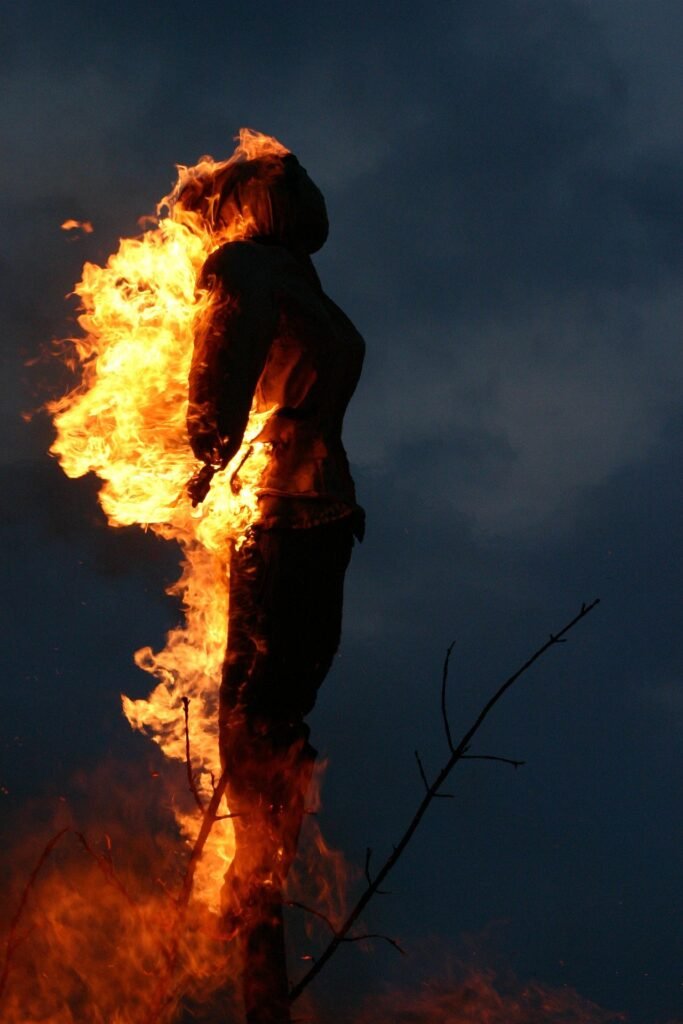
One of the most talked-about aspects of bonfire celebrations is the burning of effigies. These can be historical figures, political personalities or celebrities who have attracted public criticism. The idea is not new: Guy Fawkes himself became the familiar figure burned on bonfires across Britain, while Lewes’s history includes the burning of representations of the Pope and other figures during periods of religious conflict.
In modern celebrations, effigies can become a form of political theatre. A society may construct a giant caricature of a public figure, sometimes incorporating topical references to events that have dominated the news. The choice can provoke laughter, disagreement or outrage, which is arguably the point. Bonfire Night has long provided an opportunity for people to express their opinions in a dramatic and very public fashion.
There is, however, a distinction worth making. The famous giant celebrity effigies are particularly associated with Edenbridge in Kent, rather than being a defining feature of every Sussex event. Edenbridge has made a speciality of its enormous satirical figures, with past effigies including Katie Hopkins, Katie Price, Donald Trump and Harvey Weinstein.
Sussex celebrations have their own traditions, and effigies or tableaux vary from society to society and from year to year. That variety is part of what makes the bonfire season interesting: each event has its own personality, and the programme is never quite the same twice.
More than a single night of fireworks
It is easy to think of Bonfire Night as a few hours of entertainment, but the work behind it takes place throughout the year. Bonfire Societies are community organisations, often run by volunteers who organise fundraising activities, maintain costumes and equipment, arrange venues, prepare processions and coordinate with other societies.
Charitable fundraising is another important part of the tradition. Money raised through collections and society activities can support local causes, while membership and social events help maintain the community that surrounds each celebration. For many participants, the friendships and shared work are just as important as the bonfire itself.
The wider Sussex bonfire season also gives societies the chance to visit one another. An event in one village may include visiting groups from several neighbouring towns, each bringing its own costumes, banners and traditions. This helps explain why celebrations take place across September, October and November rather than all on the Fifth itself.
Why choose an organised display instead of a bonfire in your garden?
There is a certain appeal to gathering friends in the garden, lighting a bonfire and setting off a few fireworks. But the practical responsibilities are easy to underestimate. Fireworks and open flames can cause serious injuries, and a fire can spread rapidly if conditions are dry or the wind changes.
East Sussex Fire & Rescue Service recommends choosing an organised local event rather than holding a private bonfire or fireworks party. Organised events work with safety guidance, risk assessments and event-management plans, and larger public displays are generally safer than small private gatherings.
There are other advantages, too:
-
Professional planning: organisers consider fire safety, crowd management, emergency access and the safe positioning of fireworks.
-
Less responsibility: you do not have to buy, store or light fireworks, manage a bonfire or make sure everything is completely extinguished afterwards.
-
Better value for the evening: instead of spending money on fireworks that last only a few minutes, you can enjoy a planned display alongside a procession, music, costumes and a large communal bonfire.
-
A stronger sense of community: attending a local event supports the volunteers and societies who keep the tradition alive, and may help raise money for local causes.
-
Less stress for the host: no need to worry about guests standing too close to fireworks, children handling sparklers, smoke drifting into neighbouring gardens or a fire getting out of control.
Of course, an organised display still requires care. Sussex processions can be loud and crowded, and flaming torches, firecrackers and fireworks are not suitable for everyone. Check the event’s arrangements in advance, particularly if attending with young children or anyone with mobility needs or sensitivity to loud noise.
And spare a thought for our animal friends, both domesticated and wild. Always check beneath bonfires before lighting as hedgehogs see the piles as great places in which to hibernate. If possible, use some forks to lift and move the bonfire a few feet from where it’s built.
If you must let off fireworks near to houses, have the courtesy to advise neighbours in advance and if it’s to be in a field, make sure there are no animals in that, or neighbouring fields.
Be thoughtful, be responsible, be safe and have a enjoyable bonfire season.
Find information on local events here.


