Malta’s lengthy history in saline culture – but is it now threatened?
Hard to believe that many, many hundreds of years ago a keg of salt was worth more than its weight in gold! The same could be said for a keg of wheat germ or a keg of olive oil.
Gold had its own attractions, as well as precious stones, to ensure luxury and a good living – but what was the use of that when one could not keep body and soul together with essential foodstuffs?
the past Malta and Gozo never had large manufacturing industries and neither mineral resources such as coal and oil. The only trading items of foreign elements were products produced by nature and cultivated and nurtured. These included olives, olive oil, wheat to produce flour and natural salt.
Before the exchange of stone and metal currency as purchase requisites back in the origins of time these were very essential elements in the human exchange and barter of goods, flour and salt used to manufacture bread throughout the Mediterranean and the Middle East and a variety of other foodstuffs.
“Sapore di sale, sapore di mare” was the much loved Italian song by popular Italian singer Gino Paoli released in 1963 and which has remained popular ever since in the Maltese Islands.
It relates summer-autumn days when one breathes the aroma of salt and sea under sometimes grilling temperatures – “the aromatic perfume of salt, the aromatic perfume of sea” – and thus a time for love.
As a Mediterranean hub at the centre of the Middle Sea (Mediterranean literally means the sea in the middle of land) Malta played an essential trading port of call way back before Phoenician times and thus Malta has a very long history in the creation, cultivation and harvesting of salt, small islands surrounded by the blue Mediterranean Sea, pock-marked by caves and soft limestone rocks that could easily be hewn and cut.
For hundreds of years the economy, as it was then, or more simply the livelihoods of many thousands, depended on incoming/outgoing vessels filling up with salt, wheat germ and olive oil. The Phoenicians being traders exchanged it for other goods; military invaders looted it.
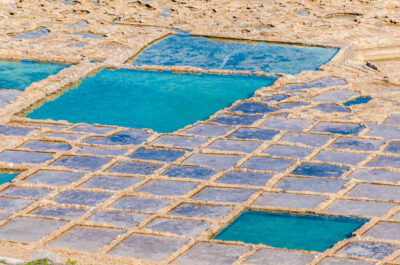
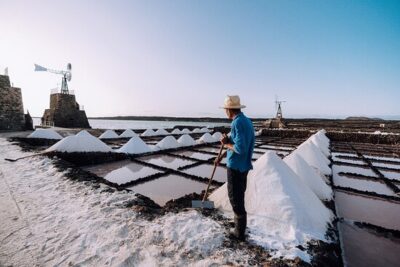
Around the coasts of Malta and Gozo there are 40 different locations where salt pans had been hewn into rocks although nowadays few are active. The production process in each locality was a family affair, the harvesting techniques being handed down from generation to generation.
Their creation was a simple enough process; shallow, square-shaped pans being hewn into rock areas that were flat and against which the sea lapped continually. The pans created shallow pools and when the sea swelled (there are virtually negligible tides in the central Mediterranean region) the square pools filled with sea water which was trapped there.
The blazing overhead sun did the rest, dehydrating the water and leaving behind the salt residue which would then be harvested by back-breaking work. The salt had to be swept into piles, cleared of foreign particles such as bits of rock, sea weeds, sea shells and other elements, and left to dry before being packed and sold.
The locations of the pans spread around the islands are mainly isolated and sometimes difficult to access, acting as a good deterrent for crowds of summer bathers that would contribute to pollution and disturb the water dehydrating in the pans.
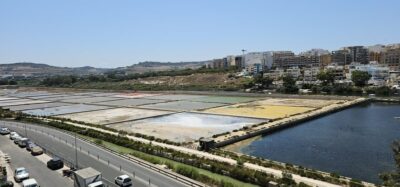
The largest pans are located in Marsalforn in Gozo, known as the Xwejni Salt Pans, on the tip of the Delimara Peninsula in the south of Malta but with the largest, most commercial and still very active pans along the Salina Coastline in the north-eastern part of Malta facing the popular resorts of Qawra and Bugibba, an overspill of St Paul’s Bay.
The Salina pans are Government controlled, originating from the time of the Knights of Malta back in the 15th and 16thCenturies and have often been totally refurbished. A breakwater stretches along Salina Bay and the sea flows into large pans and is gradually re-channeled into smaller pans and canals.
It is estimated these pans produce over 4,000 tons of coarse salt over two harvests.
As the sea water begins to dehydrate it takes on a reddish-purple hue and releases aromas that are far from pleasant. Before refurbishments took place at the Salina Pans, the area was infested with smells that resembled drainage, a stench that would be wind-carried for many kilometres depending on the wind direction. The nearby inhabitants complained bitterly of foul smells.
Eventually, all the canals, inlets and pools were scraped and cleaned and the wooden warehouses were cleaned and re-varnished and the foul smells abated.
For naturists, the pans at Salina are a magnet for birds, wallowing in the shallow waters and feeding off seaweed, sea shells and snails, small eels and fish, sea worms and other marine elements. Flamingos are migratory visitors together with a great variety of birds.
For those with medical problems, salt is a stern prohibition – but where would food and bodily needs be without a sprinkling of it?
And of course to augment the lengthy history, the very name Salina Bay is an indication of its saline propensity while further to the north in Malta the town of Mellieha literally means “salty”.


