By Gareth Butterfield 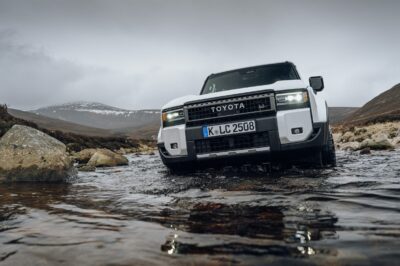
I’ve always been quite bad at timing the arrivals of the cars I have in for testing. If it’s going to snow, I’ve usually got something sporty and rear-wheel drive. And I’ve never once managed to time the arrival of a convertible with a sunny week.
But just recently I managed to get it absolutely spot on. Storm Claudia arrived the day after a bright blue Toyota Land Cruiser was delivered. It’s often joked that the Land Cruiser would be the perfect car to pull you out of an apocalypse and the weather on Friday, November 14 was certainly quite apocalyptic.
That day I had to convey my wife to a station about 40 minutes away, and a day of heavy rain and fairly violent winds made our rural round trip quite “interesting”.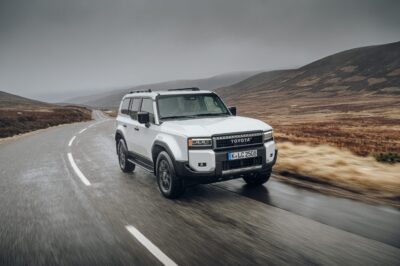
Surface spray, puddles you could swim in, submerged potholes, fallen branches, that journey had it all. Normally it would have been something of an ordeal but, in the Land Cruiser it was actually a bit of a hoot.
You have to remember the latest Land Cruiser has 70 years of proud and proven ancestry to build on. Since the 1950s, it’s been the darling of desert-dwellers, a workhorse for the agricultural industry, and the unstoppable chariot for anyone who feels the sudden urge to climb a mountain, wade through a river, or traverse a jungle.
It was, then, the perfect car for the A515 from Buxton to Ashbourne. And it handled the flooded roads better than just about any other vehicle would.
For all its technical prowess, it’s by no means a tractor of a thing to drive. It has a ladder-frame chassis, but you wouldn’t know it unless you were told. Its four-pot turbodiesel engine might sound a bit unrefined compared to the hybrids and EVs we’ve become accustomed to in recent years, but the sound is well suppressed, and it’s clearly the best tool for the job.
The interior in my high-spec test model was relatively luxurious too. The seats upfront are really comfortable, and heated, and ventilated, the screens are large and they work surprisingly well, there are plenty of physical buttons and, while you could play around with a plethora of off-road settings, you really don’t need to. The car can sort everything out for you.
Visibility is superb, there’s a brilliant 360-degree camera system, and if you spec the seven-seater version the rear seats rise up electronically.
Is it luxurious? Not really. The plastics are built-for-purpose, and the slightly ponderous road manners remind you you’re in a heavy machine that’s designed to open five-bar gates with a careless shove, but it’s certainly more pleasant to live with than it needs to be.
All this arguably unnecessary tech does mean the price starts at around £80,000, and it’s surprisingly tricky to spec them down. Although there is a commercial version available for around £50,000 plus VAT.
It is a pricey beast then, but on that hideous autumn day, navigating an unforgiving road laced with hazards, I can’t think of many cars I’d rather have been in. It really did shock me how well it handled huge puddles, and the way it manages its huge size inspires so much confidence, and you feel quite invincible.
Parking it up at the station soon brought reality back, and its bulk becomes an awkward attribute in British parking spaces, but for conveying your nearest and dearest to a train through the worst weather the UK can throw at you, it really was the perfect tool for the job.
It is, after all, a Toyota Land Cruiser, and we’ve had to wait a long time in the UK for this newest version but it completely lives up to the legend. It’s superb.


