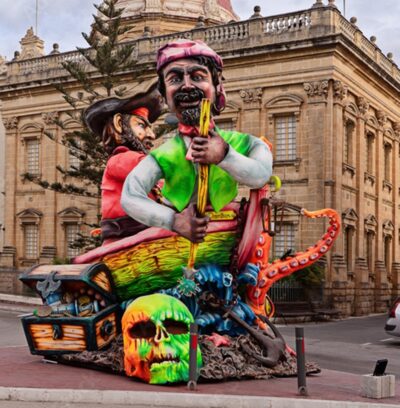
Once a year, in February/start March traditional carnivals are held in Valletta and Nadur in Gozo. Colorful parades take place in the streets. Trucks that carry giant colorful dolls, playing bands, children and adults in costumes create joyful carnival atmosphere.
The central events are held in Valletta. Similar but smaller events are held on the nearby towns and villages.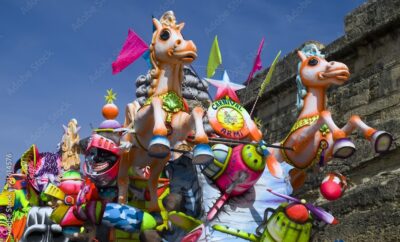
This year this vibrant celebration will be held from today, Friday 13th February to Tuesday, 17th.
It is held during the week-end leading up to Ash Wednesday and the start of the sombre Lent period and includes masked balls, fancy dress and grotesque mask competitions and lavish late-night parties.
The highlight is a colourful, ticker-tape parade of floats on the final day, headed by King Carnival and a marching band and costumes revelers.
It is one of Malta’s oldest and traditional celebrations and has been held since the 1400 but its general awakening has been since 1535.
This is five years after the arrival of the Knights of St John Cavalier in Malta.
Its first manifestation was in Birgu (Vittoriosa) where it was traditional for Knights to play games and dispose their skills in various pageants and tournaments.
However, not everything always went well and exaggerations were manifest by the Knights of different nationalities when fighting and duels as well as brawls broke out.
This displeased Grandmaster de Ponte and he made it clear that he would no longer tolerate any wild excesses, especially since they came from members of a religious community. He limited himself to approving tournaments and other military exercises necessary to Christian knights to train themselves for battle against the Ottoman Turks.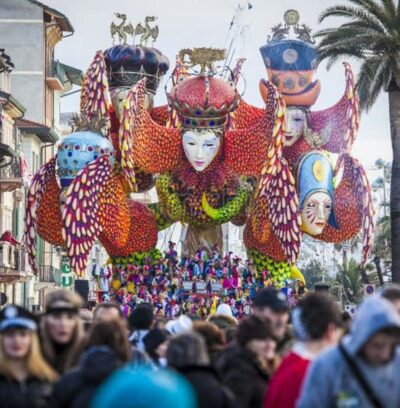
However, in 1560, Grand Master Jean Parisot de Valette, the founder of Malta’s new capital city Valletta in 1565, felt it necessary to reprimand the Kings for going overboard with their festivities, including that of indulging in sexual activities when they were sworn to celibacy!
As the years progressed the abuses became more rampant with crowd brawls fighting over provisions of sausages and bread and the advent of the arrival of the British in the 19th and early 20th centuries became noted for their more biting satirical themes, and many of the intricate floats were designed to poke fun at political figures and unpopular government decisions; however, political satire was essentially banned as a result of a law passed in 1936.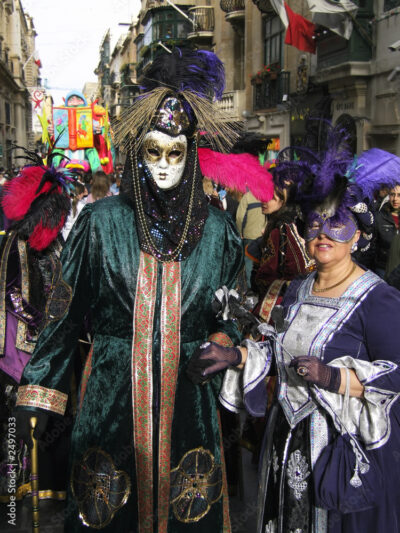
Sadly, during the Carnival of 1823, about 110 children died in a human crush after attending catechism in a nearby convent on the last day of the Carnival.
Nowadays, the largest of the carnival celebrations mainly take place in and around the capital city Valletta and neighbouring Floriana while the Nadur Carnival in Gozo remain is notable for its darker and more risqué themes including cross-dressing, ghost costumes, political figures and revelers dressed up as scantily clad clergy folk.
The Ghaxaq spontaneous carnival is an original carnival organised by the inhabitants of this locality, where people wear masks and all the old-fashioned clothes that they can find in their wardrobe.
Food consumed during carnival includes perlini (multi-coloured, sugar-coated almonds) and the prinjolata which is a towering assembly of sponge cake, biscuits, almonds and citrus fruits, topped with cream and pine nuts.
Overall it has remained traditional and popular and in more recent years has been dominated by dance displays by woman and children as well in schools.
Overall, it remains as one of the outstanding features of the islands of Malta and Gozo and it remains as a traditional “relaxation” before the sobriety of Lent for 40 days after Ash Wednesday.
ALBERT FENECH
salina46af@gmail.com


What a wonderful tradition! It sounds like such a joyful and vibrant experience, especially for families.