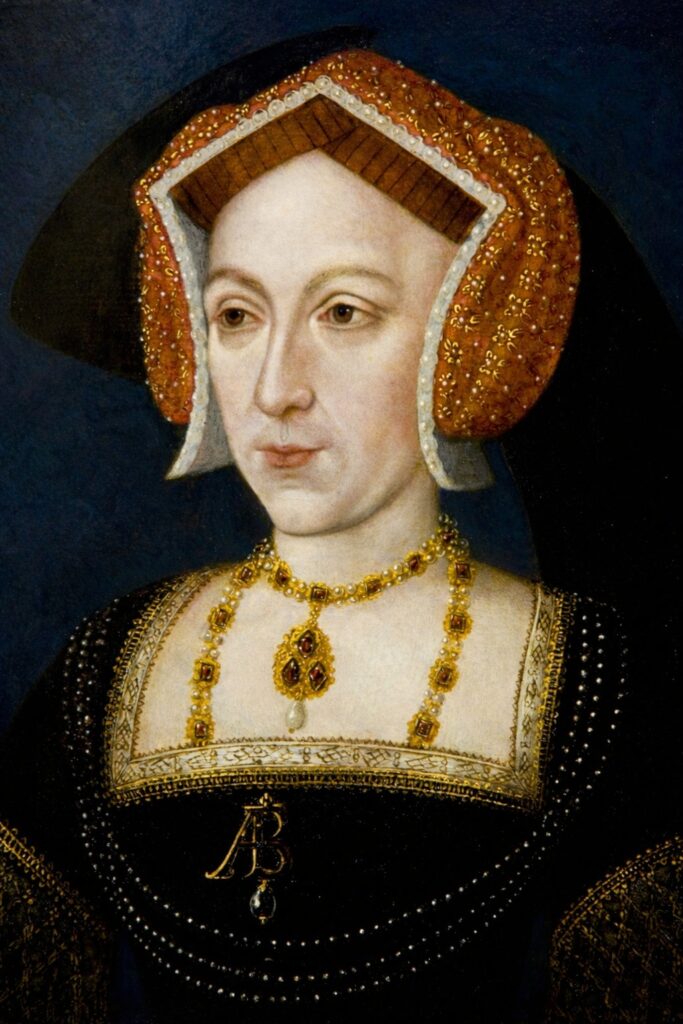
Visitors to Hever Castle’s exhibition Capturing a Queen: The Image of Anne Boleyn have the rare opportunity to encounter one of the most hotly debated portraits associated with England’s most famous queen: the Nidd Hall Portrait.
Already a centrepiece within the exhibition, the portrait has intrigued historians and Tudor enthusiasts for generations. Traditionally identified as Anne Boleyn through the prominent “AB” pendant worn by the sitter, the painting has long been regarded as one of the strongest candidates for a likeness of Henry VIII’s second queen. Yet its identity remains the subject of ongoing scholarly debate.
The Nidd Hall Portrait occupies a unique place in the search for Anne Boleyn’s face. Although the exact date of the painting remains unknown, stylistic evidence suggests it may have been produced during the reign of Elizabeth I, when interest in Anne Boleyn and her legacy experienced a revival. However, it could equally have been painted earlier. Unfortunately, the wooden panels have been so extensively trimmed that dendrochronological analysis has not been possible, preventing a more precise dating.
As with many surviving images associated with Anne Boleyn, the portrait’s identity and authenticity remain the subject of scholarly debate. Some historians argue that it preserves a genuine visual tradition of Anne’s appearance, while others suggest the image may have been altered, reinterpreted, or even misidentified over time.
Interest in the portrait intensified in 2015 when researchers at the University of California, Riverside used facial-recognition technology to compare several alleged likenesses of Anne Boleyn with the 1534 “Moost Happi” medal – the only surviving contemporary image securely associated with the queen. Among those tested, the Nidd Hall Portrait emerged as the closest match. Although researchers stressed that the findings were not conclusive, the study added a compelling modern dimension to a long-standing historical debate.
“The Nidd Hall Portrait is fascinating because it sits at the intersection of history, art and mystery,” says Dr Owen Emmerson, Assistant Curator at Hever Castle. “For centuries people have asked what Anne Boleyn looked like, yet there is no surviving portrait painted from life that we can identify with certainty. The Nidd Hall Portrait is one of the most persuasive images we have, but it also raises important questions about memory, identity and how Anne was represented after her death.”
Displayed alongside other significant portraits, miniatures and objects associated with Anne Boleyn, the Nidd Hall Portrait forms part of the largest exhibition ever dedicated to the evolution of the queen’s image. Together, these works reveal how Anne’s appearance has been reconstructed, reimagined and debated for nearly five centuries.
Set within Anne Boleyn’s childhood home, Capturing a Queen invites visitors to become part of that debate. By bringing together portraits rarely seen side by side, the exhibition encourages audiences to examine the evidence for themselves and decide which image, if any, comes closest to capturing the real Anne Boleyn.
This version removes the definitive statement that the portrait was painted “several decades after her death” and instead presents the Elizabethan dating as a plausible but unproven possibility, which better reflects the uncertainty surrounding the panel.
Set within Anne Boleyn’s childhood home, Capturing a Queen offers visitors the chance to examine the Nidd Hall portrait up close. The exhibition is included with castle admission. For more information, visit www.hevercastle.co.uk.


