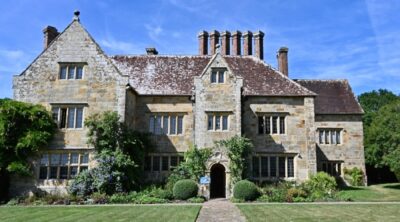
As a writer, I’m drawn to the houses of authors, especially one as revered as Rudyard Kipling.
He lived in Bateman’s, an attractive yet modest Jacobean house that’s set in 300 acres of High Weald countryside. With walled gardens, a lily pond, water mill and walks through the surrounding countryside, there’s a lot more to Bateman’s than the author’s study.
On arrival, you enter a walled garden that’s a tapestry of fruit and vegetables, interspersed with ornamental planting. I imagine it provided a lot of produce for the Kiplings. During my visit, the butterflies and bees were everywhere, complementing the careful planting and skilful selection of plants.
From here you descend into another walled garden, lined with large perennial beds, filled with a variety of insect-loving plants. There’s a natural, cottage garden feel to these borders, with plenty of drought-tolerant plants for improved sustainability in the future.
Once into the front garden, edged with yew trees, you can enjoy the splendour of the house, which overlooks simple lawns. As you approach the front door, you pass an ironstone slab, which was placed there to ward off witches, so the legend goes.
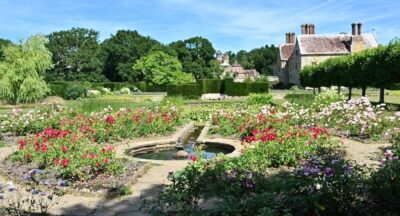
If you prefer what you can see and touch, you’ll enjoy the adjoining garden area, complete with a lily pond, rose beds and two straight rows of trimmed lime trees. Kipling designed the rose garden and lily pond, though many of the roses he planted have had to be replaced over the years.
Beyond you move into a wilder garden, served by a couple of streams. The path meanders to the Park Mill. In Kipling’s time, he used the waterwheel to power hydro-electric turbines to provide electricity for the house.
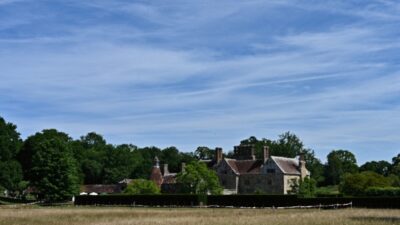
Beyond the mill, you can stroll through woodland and fields around the estate, enjoying the wildlife and peaceful setting.
With impressive panelled walls, tiled floors, grand fireplaces and oak beams, the house has a traditional air, but feels homely and loved. It looks the way it did when the Kiplings lived there. But among the splendour and polish, there was a surprise at the rear. During previous visits, I must have missed the small staircase that leads to Mrs Kipling’s office, complete with a desk, typewriter, and shelves of books.
Rudyard Kipling’s office on the first floor is a large room that speaks of knowledge and learning with floor to ceiling bookcases, globes, and notepads.
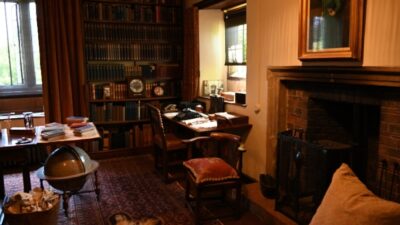
His modest writing desk, stationed below a window that looks out onto the gardens, contains his typewriter and briefcases. A larger table looks like it holds information for research. The blotter and inkwell suggest he may well have written letters there too.
The tour takes you through the bedrooms and down to the kitchen, each offering glimpses into a family man whose interests went beyond writing to embrace gardening, wildlife and the surrounding countryside.
But I think it’s the tranquillity and beauty of the setting that drew him to this lovely place outside Burwash.


It’s fascinating to think about how a writer’s home can shape their work; I find that connection really interesting too.