Spending an hour inside the Marilyn exhibition at the National Portrait Gallery in London feels a bit like stepping into a carefully constructed myth and then being asked, politely but firmly, to notice the seams.
Marilyn Monroe is one of those cultural figures who has been reproduced so many times that it is easy to forget there was ever a real person underneath the iconography. This exhibition works precisely against that erosion. Rather than presenting her as a single, fixed image—the blonde bombshell, the tragic starlet—it builds a layered portrait through the eyes of photographers and artists who each caught a different version of her.
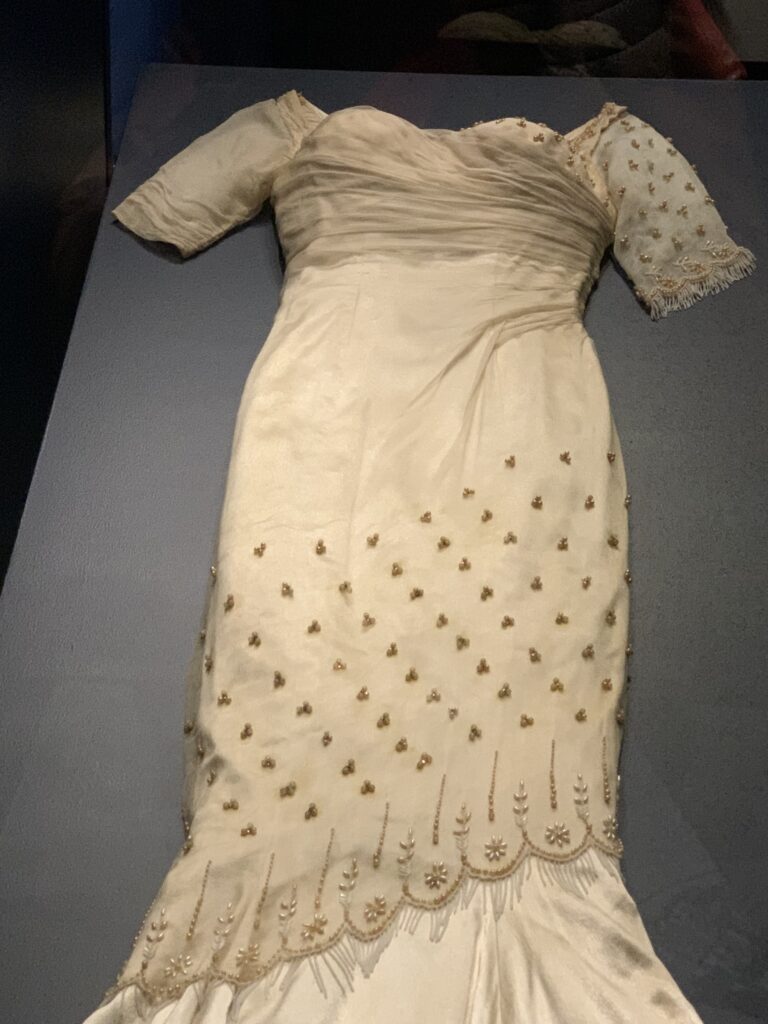
I should point out that, in contrast with the previous exhibition I reviewed at The Arches in London, here we focussed on portraiture – well, the setting of the National Portrait Gallery set the expectation. It was a delightful surprise, therefore, to find the dress Marilyn wore in The Prince and the Showgirl (1957) on display in a glass case. I hope I look as good when I get to 70 years old!
One of the first things that stands out is how dominant photography is in shaping her legacy. Cecil Beaton’s work, for example, is unmistakably theatrical. His 1956 portrait of Marilyn is all controlled elegance and studio artifice, almost like she is performing the idea of herself rather than simply sitting for a photograph. It feels poised, slightly distant, and entirely intentional.
Then you turn a corner and Eve Arnold’s images change the temperature of the room. Arnold had a long working relationship with Monroe, and her photographs strip away some of the performance. There is one particularly striking image of Marilyn on set, wrapped in a coat, looking tired and thoughtful between takes. It’s not sensationalised—it’s observational. Arnold seems to be showing us the person rather than the product, and the contrast with other portraits is stark.
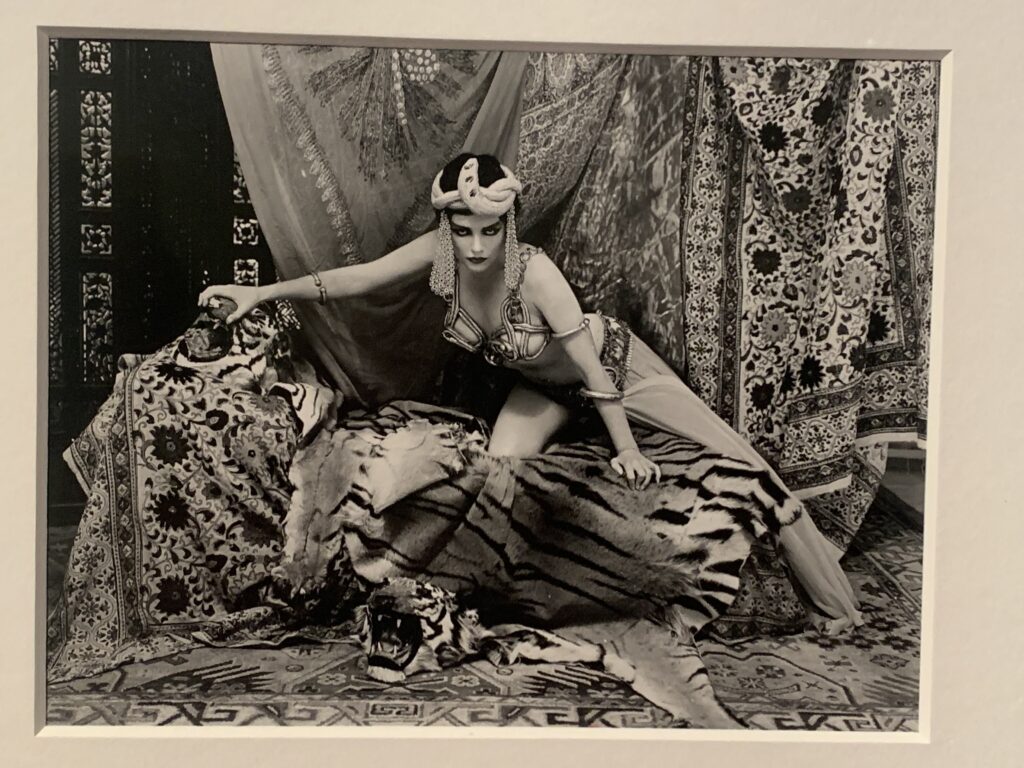
Richard Avedon’s contribution brings another layer entirely. His series of stylised, almost psychodramatic portraits of Marilyn lean into movement, distortion, and repetition. She becomes less a subject and more a force being refracted through Avedon’s own artistic language. There is something restless in these images, as though both photographer and sitter are pushing against the limits of what a portrait can contain. In addition to his depictions of Marilyn being “Marilyn,” the two created photos of her as Lillian Russell, Theda Bara and Jean Harlow. You would be extremely challenged to tell the Marilyn photos apart from the actresses being portrayed. She really could become anyone, which is one of the things that makes the “real” Marilyn so elusive.
Milton Greene’s photographs, by contrast, feel more collaborative. He co-created a body of work with Monroe that includes softer, more intimate studio sessions. These images often show her experimenting with persona—shifting between playful, vulnerable, and self-aware. What comes through strongly is that she understood the camera intimately; she was not merely being captured, she was participating in the construction of her own image.
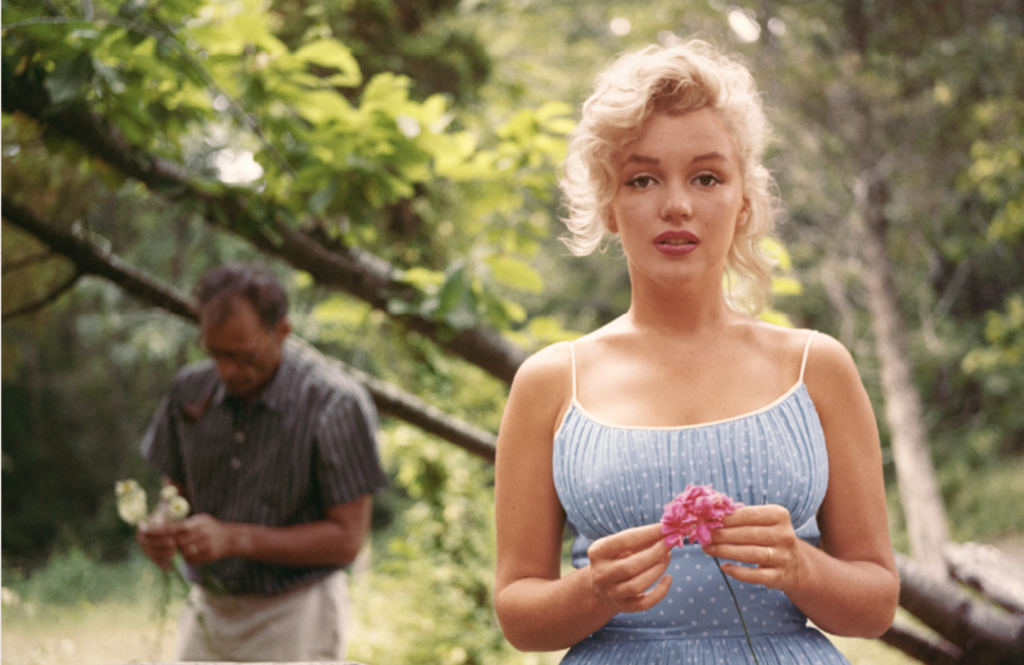
Then there are photos showing scenes of domesticity with her then husband, Arthur Miller. Sam Shaw, was another trusted photographer whose images are among the most enchanting.
There are also more candid, paparazzi-style images by photographers like George Barris, taken later in her life. These feel almost unsettling in comparison—less composed, more exposed. They remind you that the mythology of Marilyn was not just built in studios but also in the uncontrolled spaces where she could not manage how she was seen.
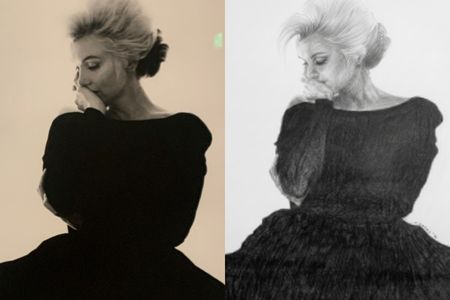
As someone who believed Marilyn became more beautiful with age, Bert Stern’s series of portraits entitled The Last Sitting features one of my favourites. I take the liberty of featuring it below, side-by-side with a freehand pencil drawing I made of this when I was 17.
The exhibition doesn’t stop at photography. It broadens into the cultural afterlife of Marilyn Monroe through artworks such as Andy Warhol’s screen prints. Warhol’s Marilyn is not a person at all in the traditional sense; she is repetition, colour, commodification. The familiar face becomes an object stripped of context, endlessly reproducible. Standing in front of it after seeing the photographs, you feel the shift from individual to icon happen almost violently.
What makes the exhibition effective is its refusal to resolve these contradictions. Marilyn is not unified here. She is fragmented across decades of interpretation: sensual, tired, glamorous, intelligent, manufactured, real. The National Portrait Gallery doesn’t attempt to stitch these versions together into a neat narrative. Instead, it lets them coexist, even when they clash.
After an hour, I left with the sense that I had not really seen Marilyn Monroe so much as witnessed the machinery built around her images and, occasionally, glimpses of the woman who existed within it. The exhibition is less about biography and more about perception: how fame is constructed, and how easily a human being can become an idea that outlives them.
It is thoughtful rather than nostalgic, restrained rather than sentimental, and all the more powerful for it.
The exhibition runs to 6 September and booking is essential – book here.


That’s a really interesting way to describe it – it does feel like being transported, doesn’t it? I was struck by how much of her vulnerability was present in the photographs.