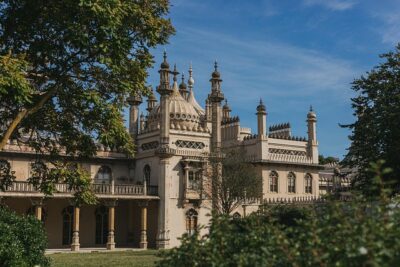
There are plenty of grand buildings in Britain. There are stately homes, castles, palaces and imposing country houses by the dozen.
And then there is Brighton’s Royal Pavilion.
With its onion-shaped domes, extravagant minarets, exotic towers and fantastical interiors, it looks as though someone has picked up an Indian palace, a Chinese fantasy and a Regency mansion, shaken them vigorously and deposited the whole lot in the middle of Brighton.
Which, as it happens, is not far from the truth.
The Royal Pavilion is one of Sussex’s most extraordinary buildings and one of those places that really does need to be seen in person to appreciate just how gloriously eccentric it is.
From seaside retreat to oriental fantasy
The story begins in the 1780s, when the future George IV, then Prince of Wales, discovered Brighton.
At the time, Brighton was developing from a rather faded fishing town into a fashionable seaside resort. Sea-bathing had become increasingly popular, particularly following the promotion of seawater treatments by Dr Richard Russell, whose medical practice was nearby in Lewes.
The young prince took to Brighton enthusiastically.
In 1787, he employed architect Henry Holland to transform the lodging house he had been renting into a fashionable villa known as the Marine Pavilion.
It was relatively restrained by the standards of what would eventually appear on the site.
George had an enormous appetite for architecture, decoration, entertaining and, frankly, spending money. As his position and ambitions grew, so did his seaside home.
When he became Prince Regent in 1811, the modest Marine Pavilion was no longer grand enough for the lavish entertaining he wanted to stage.
Enter architect John Nash.
In 1815, Nash was commissioned to transform the building, and over the following years the Pavilion acquired the extraordinary exterior we recognise today – a dramatic mixture of Indian-inspired architecture, Regency design and Chinese influences.
By the time the interior was completed in 1823, George had created something unlike any other royal residence in Britain.
It wasn’t intended to be a conventional palace. Rather, it was a pleasure palace! Somewhere to entertain, eat, listen to music, dance and indulge the imagination.
And imagination was certainly not in short supply.
Architecture that refuses to behave
The first thing you’ll notice about the Pavilion is that it doesn’t really look British.
The exterior is dominated by domes, minarets and pinnacles, while the interiors become increasingly fantastical as you move through the building.
Nash created the spectacular external appearance by placing a cast-iron framework over much of Holland’s earlier structure, allowing the building to support its extraordinary collection of domes and decorative features.
Inside, the effect is even more spectacular as the architecture and decoration combine Indian and Chinese-inspired motifs with Regency grandeur, producing something that is theatrical rather than restrained.
And that is precisely what George wanted – architecture as entertainment.
It was designed to impress guests, to demonstrate wealth and taste and, presumably, to leave them wondering quite what they had just walked into.
The interiors were largely created by designers including Frederick Crace and his father, John, rather than by Nash himself. Their work produced the elaborate Chinoiserie decoration, rich colours, dragons, exotic motifs and extraordinary decorative schemes for which the Pavilion is famous.
Prepare to look up
One of the joys of visiting the Royal Pavilion is that there is almost always something competing for your attention.
- Look at the walls.
- Then look at the ceiling.
- Then look at the furniture.
THEN look back at the ceiling because you missed something the first time.
The Banqueting Room is one of the great showpieces. It was designed for lavish royal entertaining, and the enormous dragon chandelier and richly decorated interior give you a pretty good idea of the scale of George IV’s entertaining ambitions.
Then there’s the Music Room, where Chinese-inspired decoration meets an astonishing domed ceiling.
Music and dancing were central to life at the Pavilion. George maintained his own private band and was known to sing, play the piano and conduct. The room was specifically designed with acoustics in mind, with its proportions, domed ceiling, convex coving and carpet helping to enhance performances.
In December 1823, the King’s musicians even performed for the celebrated Italian composer, Gioachino Rossini, who was visiting the palace.
The Great Kitchen: Regency technology with a royal flourish
Don’t make the mistake of thinking the kitchens are simply an afterthought.
The Great Kitchen, sometimes called the King’s Kitchen, is one of the most fascinating parts of the visit.
George was famously enthusiastic about food and entertaining, and the kitchen was designed to operate to the highest standards of the day.
It was spacious, well ventilated and technologically advanced, with water pumped from a nearby well, an enormous open fire, a smoke jack capable of turning several spits and a central steam table for keeping food warm with the capacity to prepare up to 70 separate dishes for a royal banquet.
Even the kitchen received the Pavilion treatment. Cast-iron columns are decorated with painted copper palm leaves, turning what could have been a purely functional space into another part of the palace’s visual extravaganza.
George was apparently so proud of the place that he would show visiting guests around it like an early royal show kitchen.
Don’t miss the Saloon
The Saloon is another of the Pavilion’s great visual treats.
This was the formal reception room where George would welcome his guests before accompanying them to dinner, and it was designed to make an immediate impression.
Its combination of strong primary colours, gold and platinum decoration is almost overwhelming.
The room has also benefited from a meticulous restoration programme, recreating the brilliance of Robert Jones’s original decorative scheme, completed in 1823.
This is one of those rooms where photographs really don’t convey the experience particularly well. You need to stand inside it.
A royal palace with a surprisingly human history
The Pavilion isn’t simply an architectural oddity.
Its history is intertwined with the development of Brighton itself.
George’s presence helped transform the town’s fortunes. Brighton’s population grew from around 3,620 people in 1786 to more than 40,000 by 1831, while the royal connection helped stimulate building, employment, trade and the development of the fashionable Regency architecture that still defines parts of Brighton and Hove today.
But the Pavilion’s story didn’t end when George IV died in 1830.
Queen Victoria inherited it but found the building increasingly unsuitable for her needs. In 1850 she sold the Pavilion to the town of Brighton for more than £50,000.
Much of the furniture and decoration was removed and transferred to other royal residences.
However, the story didn’t end there either.
The town opened the building to the public, and a long programme of restoration eventually began to recover and recreate much of George IV’s original vision. Restoration continues even today, with conservation specialists using surviving evidence, drawings, fragments and archival material to recreate the remarkable interiors.
The Pavilion’s wartime chapter
There is another, very different chapter in its history.
During the First World War, the Royal Pavilion became an Indian military hospital, treating wounded Indian soldiers who had been brought to Brighton.
The palace was adapted as a hospital, and the story of the soldiers who were treated there forms an important part of the building’s history today.
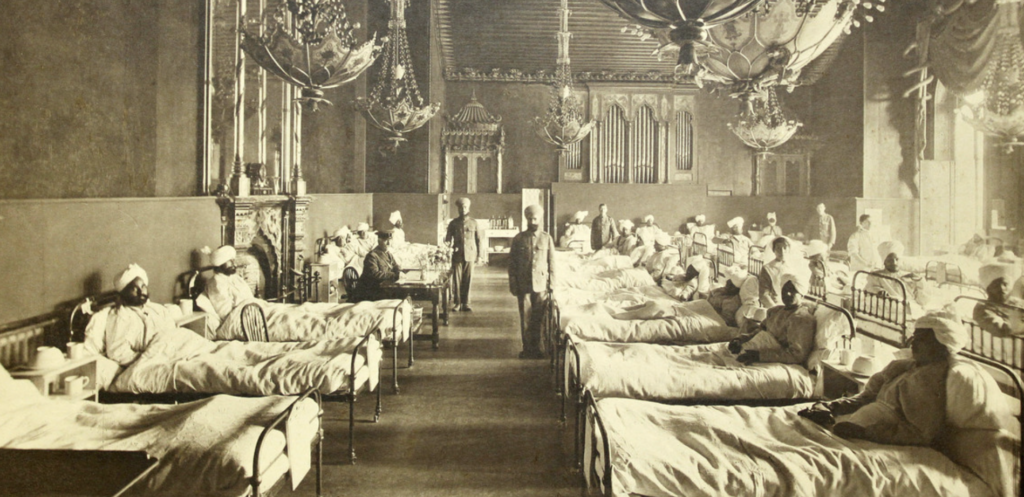
Visitors can learn more about this chapter through the Indian Hospital Gallery, which explores the experiences of the patients and the role the Pavilion played during the war.
It’s nice to know that the Pavilion has been much more than a royal playground.
What can you see today?
A visit takes you through some of the most spectacular surviving rooms, including:
- The Banqueting Room – extravagantly decorated and dominated by its huge dragon chandelier.
- The Music Room – one of the Pavilion’s most spectacular interiors, with its extraordinary domed ceiling.
- The Saloon – recently restored to its dazzling original appearance.
- The Great Kitchen – a fascinating glimpse of cutting-edge Regency food technology.
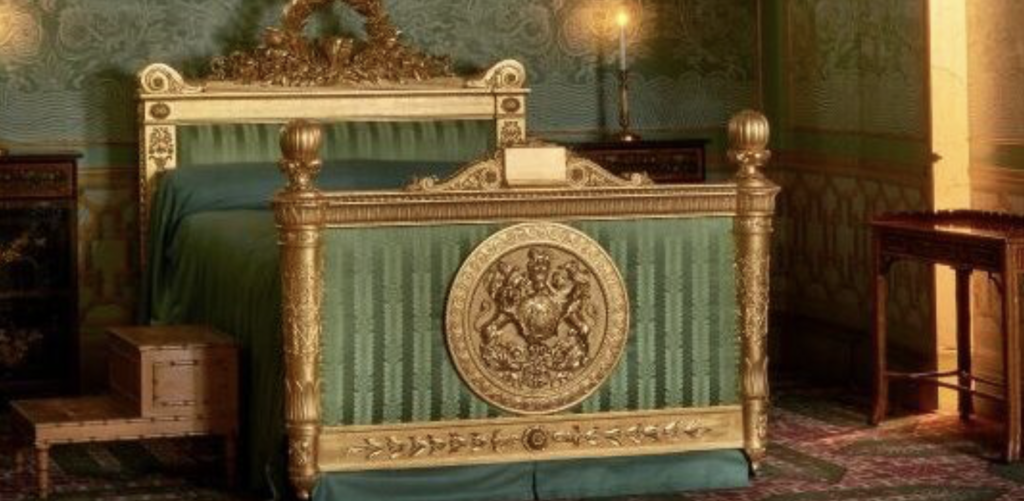
- The Royal Bedrooms – offering an insight into the private royal world.
- The Indian Hospital Gallery – exploring the Pavilion’s First World War history.
- The Regency Garden – an important part of the original pleasure-palace setting.
The Pavilion Garden is particularly worth exploring. At eight acres, it is relatively small, but it survives as a rare example of a royal pleasure garden in the heart of a modern city. It was designed in the Picturesque style associated with John Nash, with planting by royal gardener William Aiton.
And, rather wonderfully, the gardens remain a much-loved public green space rather than simply an ornamental backdrop to the palace.
Visiting the Royal Pavilion
The Royal Pavilion is open for most of the year.
October to March: 10am-5.15pm, with last admission at 4.30pm.
April to September: 9.30am-5.45pm, with last admission at 5pm.
It is closed on 25 and 26 December & 1 January, and closes from 2.30pm on 24 December.
Admission prices
Current standard admission prices are:
Adults: £21.50
Children aged 5 to 18: £13
Brighton & Hove residents: £16.50
Resident young people aged 13 to 18: £9
There are also family ticket arrangements, student concessions and free admission for accompanying carers.
Booking online gives 5% off standard adult, child and resident admission prices, while standard tickets are valid for one year, allowing return visits during that period.
The Royal Pavilion also offers a particularly useful Rail 2for1 deal, subject to the stated conditions, for visitors arriving by train.
There is an audio guide available in several languages, including English, French, German, Spanish, Italian, Polish and Mandarin.
And if you want to go beyond the standard visit, there are additional guided experiences, including the Official Tour every Saturday at 2pm, plus selected basement and tunnel tours and behind-the-scenes tours of normally restricted areas.
One of Sussex’s great oddities
The Royal Pavilion is one of those rare attractions where the phrase “you won’t see anything else quite like it” isn’t marketing hyperbole.
It really is unique.
It is extravagant without being conventionally grand, historic without feeling stuffy and eccentric without ever becoming merely kitsch.
Most importantly, it tells the story of a particular moment when Brighton was transforming from a fishing town into one of Britain’s great resorts – and when one exceptionally extravagant royal decided that his seaside retreat should look rather more like an exotic fantasy than an English country house and two centuries later, that fantasy is still standing.
And if you’ve lived in Sussex for years but never actually been inside, there’s a good chance you’ve been missing one of the county’s most extraordinary treasures.
Royal Pavilion & Garden
Brighton, BN1 1FN
Plan your visit, check current tickets and opening information


