Being the financial capital of India, Mumbai has been constantly pacing into the future. A typical busy weekday will highlight the non-stop commute of people, the honking of vehicle horns, the non-stop serpentine movement of the local trains and the rapid development of modern skyscrapers that have started dominating the city’s skyline. But there is a place in Mumbai which is like a ‘time capsule’ which suddenly catapults you in to the past. Nested in the heart of South Mumbai is Chhatrapati Shivaji Maharaj Vastu Sangrahalaya (CSMVS), (which was earlier called ‘The Prince of Wales Museum’), is a museum that is a popular tourist attraction for both local and international visitors.
The Prince of Wales (who later ruled Great Britain as King George V) was scheduled to visit India in 1905. Thus, to honour the prince’s visit, few businessmen and philanthropists of Bombay city (now known as Mumbai) proposed the British (Bombay Presidency) government to build a museum building and name it after the prince. The proposal was approved and eventually, when the prince arrived, the foundation stone was laid by the Prince of Wales himself. In 1909, George Wittet was chosen to design the museum in the Indo-Saracenic style of architecture, which is a fusion of Hindu, Islamic and Western styles. By 1914 the museum building was completely constructed, but unfortunately, due to the First World War, the museum plans had to be halted. Instead, the building was urgently used as a military hospital that was named Lady Harding War Hospital & thereafter it was used for children’s welfare centre. Finally, on 10th January 1922, the museum was officially opened for public as ‘The Prince of Wales Museum’. It was recently in 1998 the museum was renamed as Chhatrapati Shivaji Maharaj Vastu Sangrahalaya (CSMVS) (named after a native warrior king of Maharashtra) and a new addition has been the children’s museum section which has been added to this century old cultural institution.
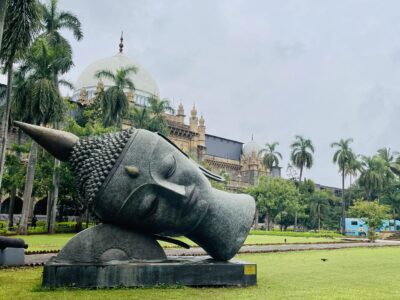
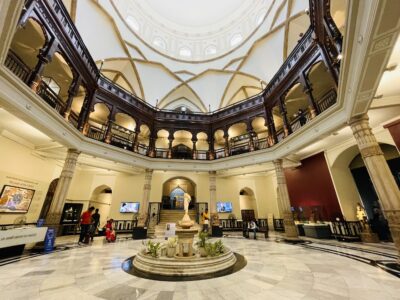
The CSMVS is spread over 3 acres of land surrounded with trees and scenic flower beds. On entering the premise there is a spacious vibe, which is a pleasant relief from the overly cramped streets of Mumbai. As one walks towards the main entrance of the museum, a uniquely laid down Buddha idol captivates one’s attention. The tranquillity radiated through the Buddha’s face has a calming effect, as one walks away from the pace & the sounds of the buzzing town that keeps fading in the background. After entering the museum building, the grandeur of the main hall with a huge dome in the centre, sets the mood for experiencing ‘larger than life’ artefacts that reconstructs the bygone years of human civilisation that is curated at the CSMVS.
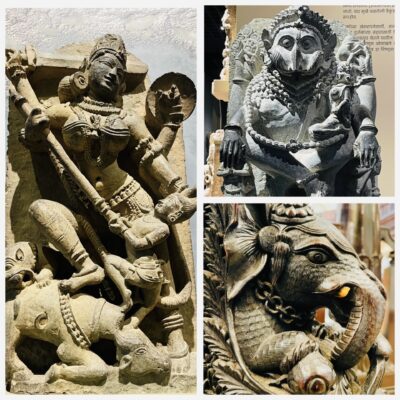
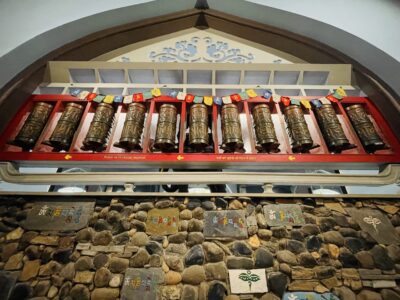
Like any other well-maintained museum, the CSMVS is a hub for experiencing rich content that has unique ‘infotainment’ value. It exhibits more than 50,000artefacts in form of idols, paintings, woodwork, metal work, photographs which certainly would appeal the curious minds of visitors who are fond of history, art, anthropology & nature. There are various galleries at the museum that offers glimpses into the past cultures, civilisations & natural history. The Himalayan gallery seems to literally transport the observer into the Himalayan region of India & Nepal, especially when one rotates the Buddhist prayer wheels that are installed in a rock structure. Yet another attraction at the museum is the natural history section where animals and birds of the Indian region have been taxidermically mounted. The exhibits, particularly, the colourful paintings and rock sculptures, from Indian mythology, like goddess Kali, Lord Vishnu & Lord Krishna, narrates stories specifically from Hindu mythology. All in all, a visit to the CSMVS certainly is an enriching experience.
In 1905 few wealthy visionaries from Bombay (now Mumbai) namely David Sassoon, Premchand Roychand, Jamshedjee Jijiboy and others, proposed the establishment of the museum at Bombay. The CSMVS, is a part of the Victorian Gothic and Art Deco Ensembles of Mumbai, which has been declared as World Heritage Site by the UNESCO in 2018. Besides this it is impressive that this institution, in its centenary year received the highest Award of Excellence at the UNESCO Asia Pacific Award for Conservation of Cultural Heritage in 2022!
Photos © Shraddha C. Sankulkar


