An East Sussex legend of witchcraft, a desperate flight and a mystery that refuses to die

Not long after moving to this area in 1998 I got a little lost driving along a back country road, trying to find a way to avoid known road works. These were the days before satnav so I was following my nose to reach a main road. As I turned down one lane, I became aware of an uneasy feeling and I became anxious to reach familiar ground a quickly as possible. As someone who’s usually practical and level-headed, this wasn’t a usual occurrence, Plus, it was mid-morning with no apparent dangers in sight so there appeared to be no reason for my unease.
This happened near Buxted in East Sussex, and I was on Nan Tuck’s Lane. I noted the name as it was unusual and looked it up on my return home. What I discovered gave me chills.
It recalls a woman said to have been accused of witchcraft and the poisoning of her husband. The story is that she was pursued by villagers and disappeared under circumstances that have never been satisfactorily explained.
According to local legend, Nan Tuck disappeared while fleeing those pursuers. Some versions say she was never seen again. Others tell of a terrible death in the woods, followed by reports that her ghost haunted the lane where she made her desperate escape.
Was Nan Tuck a real woman whose fate became distorted through generations of storytelling? Was she a victim of fear and rumour, or was there some truth behind the accusations made against her? As befitting a legend, the surviving accounts don’t provide a clear answer. What they do offer is a distinctly Sussex mystery, one in which a real place name has kept an old and disturbing tale alive.
A woman under suspicion
The traditional story places Nan Tuck in the Buxted area, although accounts differ over the precise date of the events. Some place her in the seventeenth century; others suggest a later period. The details of her life before the accusations are equally uncertain.
The story generally begins with the sudden death of her husband. Suspicion fell upon Nan, and she was accused of poisoning him. In some versions, the accusation was accompanied by another: that she practised witchcraft.
It’s worth pausing over that combination. A death that could not readily be explained might invite suspicion, particularly when the person left behind was already regarded as unusual or different. In a small community, rumour could spread quickly, and an accusation might become accepted as fact long before anyone had established what had actually happened.
We should not assume that Nan was guilty of either crime. No reliable evidence has been established here to confirm the alleged poisoning, and the surviving folklore does not provide a dependable account of a trial or conviction. The story belongs, at least in the form in which it has reached us, to the uncertain territory between local history and legend. As was common at the time, it’s quite possible Nan’s only “crime” was being a woman who didn’t quite fit the mould.
And perhaps she owned a cat!
Yet the accusation was only the beginning. In the most familiar versions of the tale, Nan fled, and the villagers pursued her.
The flight into the woods
Imagine the Sussex countryside before modern roads, any street lighting and the easy mobility we take for granted. Lanes connected scattered settlements, fields gave way to hedgerows, and woodland could offer shelter to someone who knew the ground well.
According to the legend, Nan escaped from those seeking to apprehend her. Some accounts describe her hiding in fields or hayricks before moving on. Others suggest she was trying to reach the protection of a church. The stories agree on the essential drama: she was being hunted, and her pursuers believed they were closing in.
Nan Tuck’s Lane became associated with this flight. But what happened when she reached the wooded ground is where the accounts begin to diverge.
In one version, Nan vanished without trace. Her pursuers could find neither her nor a satisfactory explanation for her disappearance. In another, she was caught and killed. Some tellings say she was found hanged in the wood; others suggest that the circumstances of her death were concealed or misrepresented.
The uncertainty is central to the legend. There is no single, securely documented narrative that settles her fate. Instead, different versions have accumulated around the same landscape, each adding another possibility to the mystery.
It is easy to see how the story might have grown. If a woman had disappeared after being accused of a serious crime, unanswered questions could have survived long after any contemporary witnesses had died. Over time, speculation might have hardened into local tradition, with the lane itself serving as a permanent reminder of the tale.

Witchcraft and the power of accusation
The accusation that Nan Tuck was a witch gives the story much of its enduring darkness.
Belief in witchcraft formed part of the cultural and religious life of early modern England. People might turn to supernatural explanations for illness, sudden death, misfortune or events they could not understand. Those already regarded as troublesome, eccentric or socially isolated could be particularly vulnerable to suspicion.
Witchcraft accusations were not always about a belief that someone possessed supernatural powers. They could also reflect personal grievances, neighbourly disputes, fear and the desire to find someone to blame. Once suspicion took hold, it could be difficult for the accused to escape its consequences.
That historical context helps us understand why a tale such as Nan Tuck’s could have developed, but it does not establish that she was accused during a particular witchcraft prosecution. The details of her alleged crimes and disappearance remain unverified.
Nor should we assume that every person labelled a witch was formally tried or executed. Popular belief, local gossip and the legal process were not the same thing. In Nan’s case, the absence of a firmly established documentary account leaves us unable to say precisely what happened, or even whether the central events occurred as the legend describes them.
Perhaps the most troubling aspect of the story is not the possibility of witchcraft, but the possibility of what people might do when they believe an accusation without demanding proof. We still see this mentality today, particularly where a mob gathers and group think kicks in, often taking 2+2, making 5 and acting on it with no real evidence.
The patch where nothing grows
A particularly persistent element of the Nan Tuck legend concerns a patch of ground in the woodland where, it is said, nothing will grow.
Some versions associate this barren spot with the place where Nan died. Others present it as a lingering sign of the terrible events that supposedly took place there. The ground becomes more than a geographical feature: it is treated as evidence that the past has left a mark on the landscape.
Such details are common in folklore. A strange-looking tree, an unusual hollow, a stretch of barren earth or a bend in a road can become attached to a story and then be interpreted through it. Once people know the legend, they may see the place differently. What might otherwise be an unremarkable patch of ground becomes a focus for curiosity and unease.
Whether there is a particular barren patch associated with Nan Tuck today, and what might account for its condition, would need to be established independently. The claim that nothing grows there should be understood as part of the tradition rather than as proof of a supernatural event.
Nevertheless, it’s a powerful image. In the story, the earth itself seems unable to forget what happened.
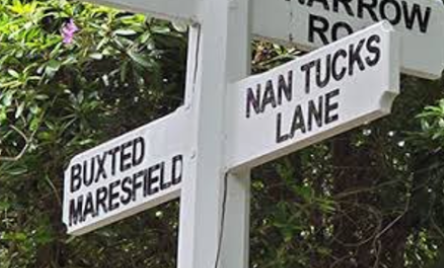
Does Nan Tuck still haunt the lane?
Local accounts say that Nan Tuck’s ghost haunted the lane and the surrounding area. Some tellings describe her spirit retracing the route of her escape; others simply preserve the belief that the place is haunted.
The Buxted Parish Council’s local history pages record the legend, describing Nan as a woman who murdered her husband, escaped the authorities and later haunted the old lane towards Rotherfield. The council’s account also notes that the story has not been widely reported as a sighting in recent years.
This lack of recent sightings has done nothing to dispel the legend. Ghost stories are often sustained not by constant reports of apparitions but by the memory of earlier tales. A place acquires a reputation, and each new generation inherits the story, whether or not anyone claims to have seen anything unusual…. But there was that uneasy feeling that crept over me before I knew anything of Nan Tuck.
There is no verified evidence that Nan Tuck’s ghost exists. But the endurance of the legend is a different matter. Her name remains attached to the lane, and the story continues to appear in local accounts of Sussex folklore.
For some, that may be enough to make the place feel unsettling. Knowing that a road is supposedly haunted can change the experience of travelling along it, especially when the surroundings are quiet and the trees close in overhead. The imagination has a way of filling empty spaces.
And perhaps that is part of the appeal. A ghost story does not always need a convincing sighting. Sometimes the possibility, however slight, is enough.
I can tell you, from speaking with locals here, that you won’t find many out and about in the area after dark tonight on All Hallow’s Eve.