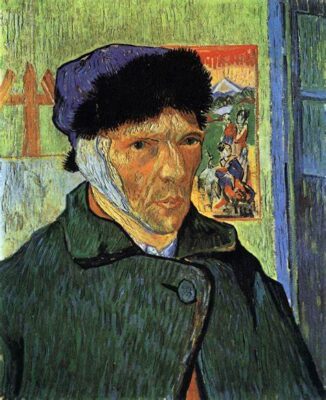
One of the most bizarre and notable events of art history occurred 23rd December 1888 when Dutch artist Vincent Van Gogh cut of his left ear in an apparent fit of pique. What provoked this act of mutilation? What happened to the severed ear? Why paint a self-portrait depicting a bandaged right ear?
In 1888 the small French town of Arles in Provence had little to commend it apart from the reputed beauty of its women, the “Arlesiennes”. Bizet, French composer of Carmen, wrote a musical tribute to the beautiful “Arlesiennes”, their reputation legendary. However, that’s all it was, legend. Vincent Van Gogh was lonely and looking for love so Arles appeared an attractive destination. He soon discovered the women did not live up to the myth, showed no interest associating with or posing for him. ‘The unsatisfied need for kindness and sympathy – that is what’s hard to bear’ he wrote to his brother, Theo. In fact the local women feared him and labelled him le fou roux (the red-haired madman), so he resorted to the local brothel to experience the “love” and a form of companionship he so desperately craved.
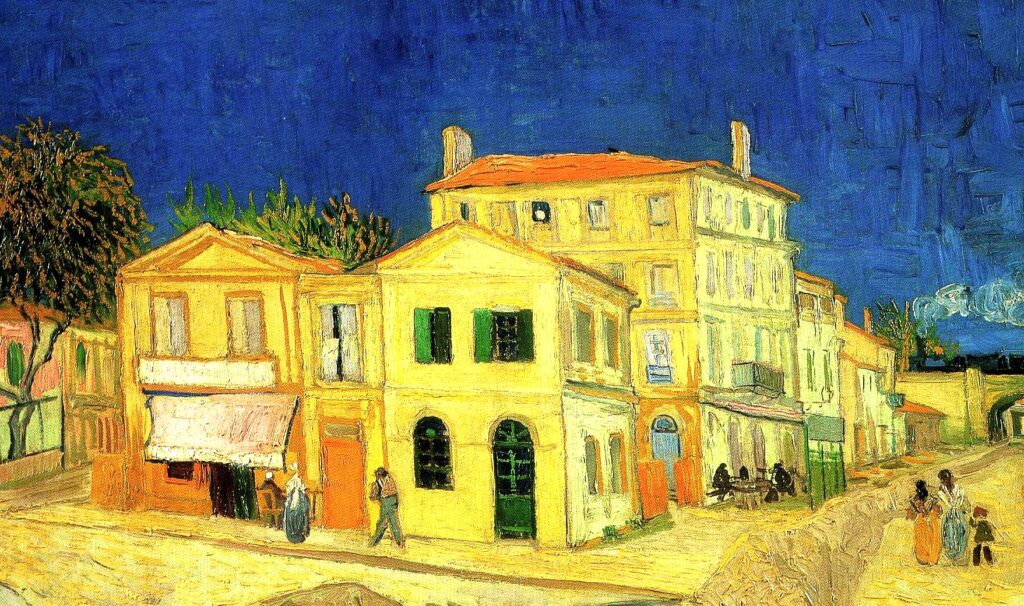
Vincent rented a house with the intention of establishing an artist colony but none of the painters he invited took up the offer, except Paul Gauguin (1848 – 1903). Unbeknown to Vincent, Gauguin was penniless and only arrived because Theo Van Gogh, Vincent’s brother, financed his travel and board-and-lodging to keep an eye on Vincent’s increasingly erratic behaviour that verged on insanity.
Vincent painted his famous sunflower works to decorate Gauguin’s room. Gauguin was not impressed and the pair never hit it off; there was intense rivalry and constant arguments concerning their fundamentally different philosophies regarding art and life. Vincent was intensely jealous of Gauguin’s success with women and complained in a letter to his brother that Gauguin always got more for his franc than he did. The two also frequented a late-night bar owned by Marie Ginoux. She refused to pose for Vincent but said yes to Gauguin. A waitress at the café, eighteen-year-old Gabrielle Berlatier, attracted Vincent’s eye. She also worked as a maid serving drinks at the local brothel.
Vincent had a history with prostitutes and contracted syphilis. The only woman who deigned to live with him was a sad, worn-out brunette called Clasina Maria Hoornik, a prostitute from The Hague. When Vincent met her, she was pregnant with her fourth child. Vincent’s family were appalled, his father a minister in the Dutch Reform Church, but because of his strict religious upbringing Vincent saw prostitutes in a biblical light, saintly figures like Mary Magdalene, the most renowned and revered prostitute in Christianity. The Bible doesn’t actually say she was a prostitute but if you’ve read The Davinci Code, that’s the myth around her that appealed to so many artists down the centuries.
Returning home after a night of drinking a ferocious argument erupted with Gauguin. Vincent threatened Gauguin with a razor, Gauguin stared him down and Vincent ran home and cut off his left ear. Why this act of self-mutilation? Art critic Waldemar Januszczak offers a compelling explanation.
Bull fights were staged in Arles several times a year and we know Vincent attended the bull ring because he painted the scene, with Marie Ginoux a spectator. After the matador slays the bull, the ear of the bull is cut off and he parades around the ring proudly holding up the ear as a symbol of victory to the baying spectators before throwing it into the crowd to the most beautiful women he can see.
Vincent bandaged the profusely bleeding wound with a cloth, wrapped the ear in newspaper and dragged himself down the street to the brothel and gave it to eighteen-year-old Gabrielle Berlatier, who upon opening the packet promptly fainted. It is likely the argument with Gauguin concerned Vincent’s affection for Gabrielle who may have been attracted to Gauguin, and in giving the severed ear to the girl he thought he was in love with, Vincent was casting himself as the defeated bull, the sacrificial victim in the struggle for love.
Vincent was later discovered lying in the street by a policeman and treated by a medical student before being taken to hospital. Gauguin moved out and Vincent painted his famous self-portrait with bandaged right ear using a mirror, hence the wrong ear. It’s a painting about suffering and rejection. Remember that Vincent was raised in an intensely religious family environment so he knew all about the suffering of Jesus on the cross which forms the subtext of this self-portrait. The easel in the background is in the shape of a cross and Vincent is identifying himself with Jesus. While Christ has his loincloth, Vincent has his grubby bandage. Afterwards, he painted a version of the Pieta and explicably gave the dead Christ his own face.
Whenever you see a painting of Jesus’ crucifixion on Mount Calvary, Mary Magdalene will be at Christ’s feet in mourning. Vincent was influenced by Japanese art, and sure enough, Vincent has his “Mary Magdalene” in the guise of a Japanese Geisha whilst Mount Fuji substitutes for Calvary.
We assume the infamous ear was binned in disgust. Today, of course, the ear would auction for millions, but the Van Gogh Museum in Amsterdam have the next best version. In 2016 they staged an exhibition entitled On the Verge of Insanity which displayed a flesh replica of Vincent’s ear, bioengineered from genetic material from his living descendants, preserved in a small glass tank.


