There are some buildings you visit, and there are others that seem to have been waiting for you for centuries.
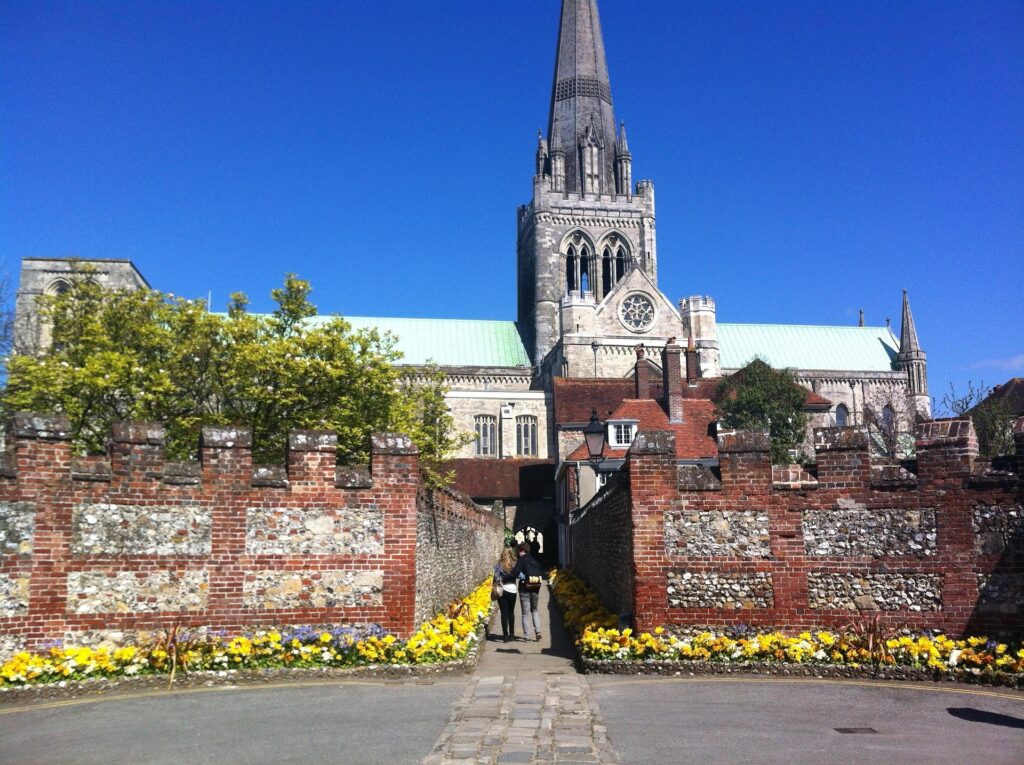
Chichester Cathedral falls firmly into the second category.
Standing at the heart of the city, its magnificent spire rises above the rooftops and has become one of the defining landmarks of West Sussex. But the Cathedral is far more than an impressive silhouette. Step through its doors and you are stepping into almost a thousand years of history, art, music, faith, destruction, rebuilding and some extraordinary architecture.
And if you have ever looked up at that famous spire and wondered what Chichester looks like from the top, you now have an opportunity to find out because this autumn, members of the public are invited to climb it!
Nearly 1,000 years of history
The story of Chichester Cathedral actually begins away from Chichester.
In 681, St Wilfrid founded a monastery at Selsey, around ten miles from the present city. It became the first cathedral in Sussex. Following the Norman Conquest, however, the bishopric was moved from Selsey to the more populous Roman city of Chichester.
Construction of the new cathedral began in 1075, using stone brought from Quarr on the Isle of Wight. The building was eventually completed and consecrated in 1108.
That might sound like the end of the story but it was barely the beginning.
It seems to be a popular occupation of Cathedrals to suffer devastating fires and Chichester’s was no exception enjoying its first in 1114 and another in 1187, that destroyed much of the wooden roof and the eastern end. The building was subsequently remodelled with a stone-vaulted roof and was reconsecrated in 1199.
Then came medieval pilgrims, Tudor monarchs, the Reformation, the Civil War and the Restoration.
Chichester itself was besieged during the English Civil War in 1642 and the Cathedral was badly ransacked. Restoration work followed after the return of the monarchy.
Then, in 1861, something rather dramatic happened.
The tower and spire collapsed – yikes!.
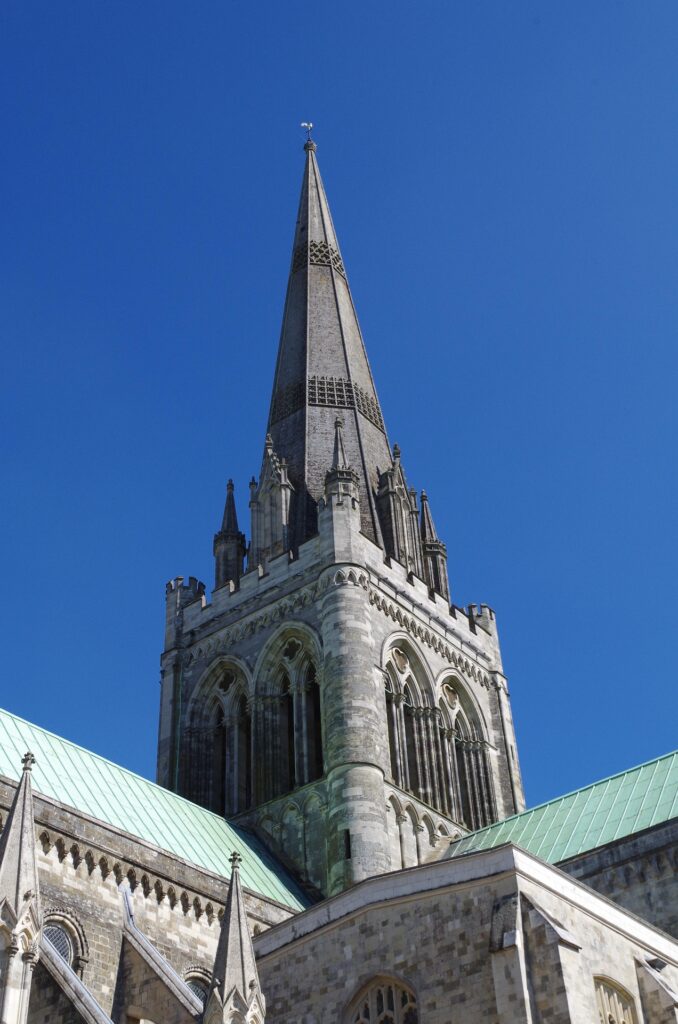
Fortunately, the story did not end there either. Sir George Gilbert Scott oversaw an ambitious rebuilding programme which took over five years. The Cathedral was fully reopened for worship in 1866 showing off new tower and spire, both largely faithful to their predecessors.
So when you stand beneath that elegant spire today, you are looking at something with a true survival story.
A building where old meets new
Architecturally, what makes Chichester Cathedral fascinating is that it isn’t a snapshot of one particular period.
It’s a building that has evolved over more than nine centuries and, along the way, has garnered Norman architecture, medieval Gothic work, Victorian restoration and an extraordinary collection of twentieth-century art. The result is a place where ancient stonework and modern artistic expression sit comfortably alongside one another.
Look closely at the stone carvings and medieval details and you can spend hours discovering things that would be easily missed if you simply wander through.
The Cathedral is Grade I listed and its soaring spire remaining one of its most recognisable features.
As well as what’s above you, one of the most intriguing things about Chichester Cathedral is what lies beneath your feet.
A Roman surprise beneath the Cathedral
Long before the Cathedral was built, Chichester was an important Roman settlement known as Noviomagus Reginorum.
Excavations have revealed evidence of a substantial Roman building beneath the Cathedral precinct, and part of a second-century Roman mosaic can be seen through a glass walkway in the South Aisle.
It is one of those details that makes a visit extra rewarding.
You can be standing inside an almost 1,000-year-old Christian cathedral while looking down at something created roughly 1,800 years ago.
So history here comes in layers.
Look out for the art
If you imagine that medieval cathedrals are all about ancient stone, stained glass and solemn-looking tombs, Chichester has a surprise in store.
The Cathedral has an impressive collection of modern and contemporary art.
Among the most celebrated works is John Piper’s enormous tapestry behind the High Altar. Created in 1966, its vivid colours and dramatic abstract forms are a striking contrast to the ancient architecture in which it sits.
There is also Graham Sutherland’s powerful Noli Me Tangere, as well as work by Marc Chagall and other important twentieth-century artists.
The famous Chagall window is spectacular when sunlight catches the coloured glass.
And then there is the Shrine of St Richard, commemorating Richard of Wych, Bishop of Chichester from 1245 to 1253. After his canonisation, the shrine became an important destination for medieval pilgrims and remains a place of prayer and reflection today.
This is not a building to tick off in ten minutes before heading for coffee. It pays to take your time and peel back all those layers.
And then we reach the spire…
The Cathedral’s spire catches the eye from some distance across Chichester but now you can get much closer to it.
The Cathedral’s Spire Visits offer the chance to climb through parts of the building that aren’t normally open to the public, accompanied by knowledgeable Cathedral volunteers.
The journey takes around 45 minutes and involves 164 steps (you have been warned) winding staircases and roof spaces that most visitors never get to see.
So beware of the climbing involved in a visit. You won’t be able to call an elevator but your effort will be amply rewarded.
At the top, visitors reach the Cathedral’s Lantern and are treated to panoramic views across Chichester and the surrounding Sussex landscape.
On a clear day, you can see towards Goodwood, Portsmouth and the Isle of Wight.
Suddenly you get to see that elegant little city centre you may have just walked through from a totally different perspective.
What makes the Spire Visit special?
Part of the appeal is the view, obviously.
But the experience is really about seeing the Cathedral from the inside out.
You discover the roof spaces, climb the winding staircases and learn more about the construction and history of the building from volunteers who know it intimately.
You also get a rather different appreciation of the engineering involved in creating and maintaining a medieval cathedral.
Standing up there, looking across Sussex, you can perhaps understand why the spire has been such an important part of Chichester’s identity.
A cathedral that is still very much alive
Despite the historic setting and artefacts, Chichester Cathedral is still a working place of worship, with services taking place throughout the week. Music is an important part of Cathedral life too, from choral services to concerts and lunchtime performances.
There are guided tours for those who want to understand more about the history, architecture and art, while families can explore with activities designed to bring the building’s history to life.
And when you’ve finished exploring, there is the Cloisters Kitchen & Garden, tucked into the Cathedral’s historic cloisters, where you can stop for coffee, lunch or something sweet.
An opportunity to get your strength back after those 164 steps to the spire.
Planning your visit
Chichester Cathedral is open to visitors throughout the year, although opening times can vary around services and special events.
Admission to the Cathedral itself is by donation, with a suggestion of £7 per visitor.
The Cathedral’s regular guided tours run Monday to Saturday at 11.30am and 2.30pm and cost £5 per person.
Spire Visits must be booked in advance. They currently cost £20 for adults, £16 for students and £14 for children, with the experience lasting approximately 45 minutes.
Due to the 164 step climb coupled with winding staircases, this visit won’t be suitable for everyone and sensible footwear is recommended. Check the Cathedral’s current terms and conditions before booking.
For the latest Spire Visit dates and availability, visit the Chichester Cathedral Spire Visits page.
For general visitor information, see Chichester Cathedral.
You can also find the experience listed by The Great Sussex Way.
Look up before you leave
Chichester Cathedral is one of those places where looking up is almost as important as looking around.
Look at the medieval stonework. Look at the stained glass. Look at Piper’s extraordinary tapestry. Look down at the Roman mosaic.
And, of course, look up at the spire.
It has dominated the Chichester skyline for generations, survived catastrophes and been rebuilt.
Now, thanks to the Spire Visits, you can climb inside it and see the city in a way that few people have.
After nearly 1,000 years, Chichester Cathedral still has a few secrets left at the top.


