There are cities that impress with a single landmark, and there are cities that tell their story through every street. Liverpool is undoubtedly one of the latter. From soaring cathedrals and magnificent waterfront architecture to regenerated docklands and striking contemporary buildings, the city offers an architectural journey spanning almost 300 years.
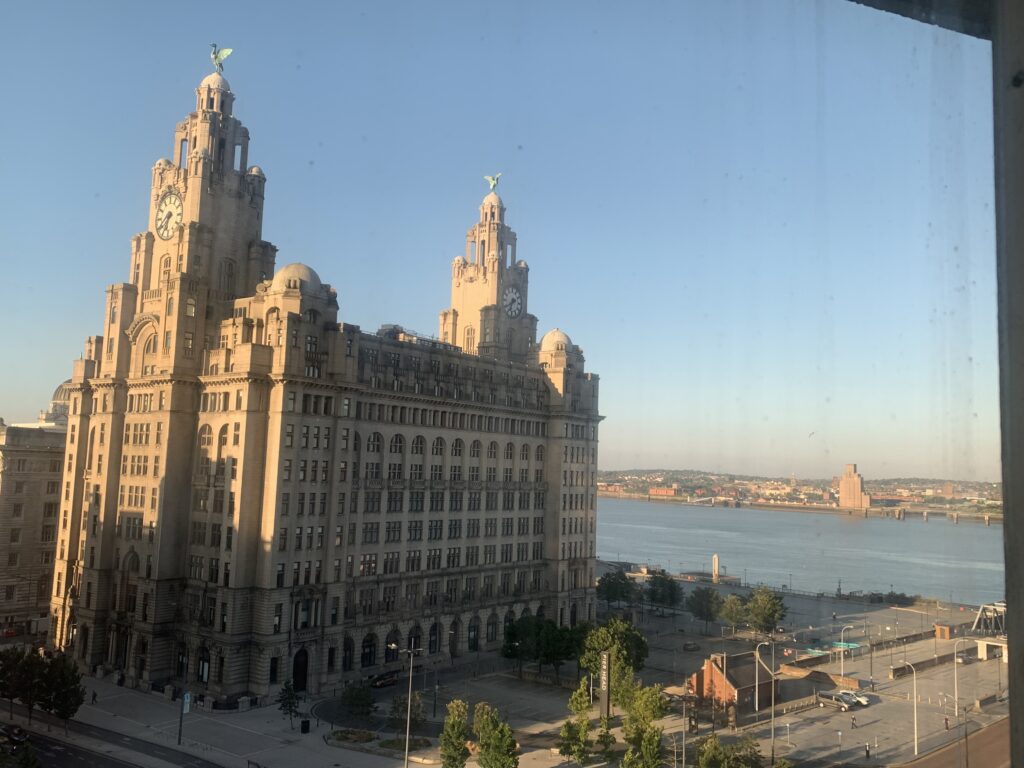
Walking through Liverpool is like turning the pages of a history book, where Georgian elegance sits comfortably alongside Victorian grandeur and bold modern design. A city that boasts more Georgian buildings than Bath and the most listed buildings outside of London. It is a city that has continually reinvented itself without losing sight of the heritage that made it one of Britain’s greatest ports.
No visit should begin anywhere other than the waterfront.
Dominating the skyline are Liverpool’s famous Three Graces – the Royal Liver Building, the Cunard Building and the Port of Liverpool Building. Standing proudly along the Pier Head, these magnificent early 20th-century buildings symbolise the city’s maritime prosperity during the height of the British Empire. The Royal Liver Building, completed in 1911, remains perhaps the best known, crowned by its iconic Liver Birds that have watched over the city for more than a century. Together, the three buildings create one of Britain’s most recognisable waterfronts and serve as a reminder of Liverpool’s importance as a global trading hub. The Port of Liverpool Building was based on a rejected design that was originally submitted for the Anglican cathedral.
Not far from the nearby Port of Liverpool Ferry Terminal, check out The Beatles statue, donated to the city by The Cavern Club. Depending on when you visit, you may have to join a line of tourists to take your photo with the fab four, but it’s worth seeing. it was sculpted by artist Andy Edwards (more on him further down) in 2015 and shows John, Paul, George and Ringo casually strolling along in their cuban-heeled cowboy boots, coats flapping in the wind from the Mersey.
Just a short stroll away lies the beautifully restored Royal Albert Dock, where history and modern tourism blend seamlessly. Opened in 1846, it was revolutionary in its day, becoming the first warehouse complex in Britain to be constructed entirely from cast iron, brick and stone, with no structural timber. Once bustling with cargo from around the world, the dock now houses restaurants, cafés, independent shops and galleries while retaining its original industrial character. Watching visitors wander the quayside where dock workers once loaded tea, cotton and tobacco is a reminder of just how successfully Liverpool has breathed new life into its historic waterfront.
The Albert Dock became a regular morning fixture in homes across the UK in the late 1980s when the This Morning breakfast show featuring Richard & Judy broadcast from studios there. A memorable feature was the floating map of the British Isles on which the weather presenter would bounce around advising the country of the need for brollies, sunscreen, coats and hats. One at least one memorable occasion, the event we’d all been waiting for actually happened when the presenter ended up bouncing right off one of the smaller counties of England, landing in the water.
Regeneration continues beyond the Albert Dock. Vast areas of the former docklands, once left derelict following the decline of traditional shipping, have undergone remarkable transformation over recent decades. New homes, hotels, museums, offices and leisure attractions now stand alongside carefully preserved historic warehouses, while projects such as Everton’s spectacular new stadium at Bramley-Moore Dock demonstrate that Liverpool continues to invest confidently in its future without erasing its past.
One of the finest additions to the waterfront is the Museum of Liverpool. Opened in 2011, its bold, angular design provides a striking contrast to the classical elegance of the Three Graces opposite. Inside, the museum tells the city’s remarkable story through fascinating exhibitions covering everything from its maritime heritage and sporting achievements to The Beatles, immigration, social history and everyday Liverpudlian life. It’s an ideal introduction for anyone wanting to understand what makes Liverpool such a unique and resilient city.
Looking inland, Liverpool’s skyline is dominated by two extraordinary cathedrals that couldn’t be more different in appearance yet complement one another beautifully.
The Liverpool Cathedral, often known as the Anglican Cathedral, is Britain’s largest cathedral and one of the biggest in the world. Designed by Giles Gilbert Scott, construction spanned almost three-quarters of a century, finally being completed in 1978. Built from warm red sandstone – mostly mined from Woolton Quarry, located in the southern suburbs of the city and famous for being the home of John Lennon and his first band, the Quarrymen. The cathedral’s soaring tower can be seen from miles away, while the vast Gothic interior inspires awe with its towering arches, magnificent stained glass and sense of quiet grandeur. Even visitors with little interest in architecture often find themselves stopping simply to admire its sheer scale.
At the opposite end of the street stands the Metropolitan Cathedral of Christ the King, Liverpool’s Roman Catholic cathedral. Nicknamed “Paddy’s Wigwam” by locals, its striking circular design and dramatic crown-like roof could hardly provide a greater contrast to its Anglican neighbour. Completed in 1967, the cathedral embraces modernist architecture with colourful stained glass flooding the interior with remarkable patterns of light. This cathedral was originally planned to be built in a traditional church style. Commissioned in the 1930s and designed by Sir Edwin Lutyens, it was to be a Gothic-Renaissance building and would have become the second largest church in the world. Following World War II, however, with building materials scarce and finances squeezed, only the brick crypt was finished and the design was changed to what we see today. It’s another “must see” sight which is unique and beautiful both inside and out.
Together, the two cathedrals represent not only different architectural styles but also Liverpool’s rich religious and cultural heritage, standing just under a mile apart and connected by the appropriately named Hope Street. An interesting side fact is that the Anglican Cathedral was designed by devout Catholic architect, Sir Giles Gilbert Scott and the Catholic Cathedral was designed by Protestant architect, Sir Frederick Gibberd, reflecting the melting pot into which both buildings fit.
Situated between them and a couple of streets south sits one of Liverpool’s most poignant landmarks.
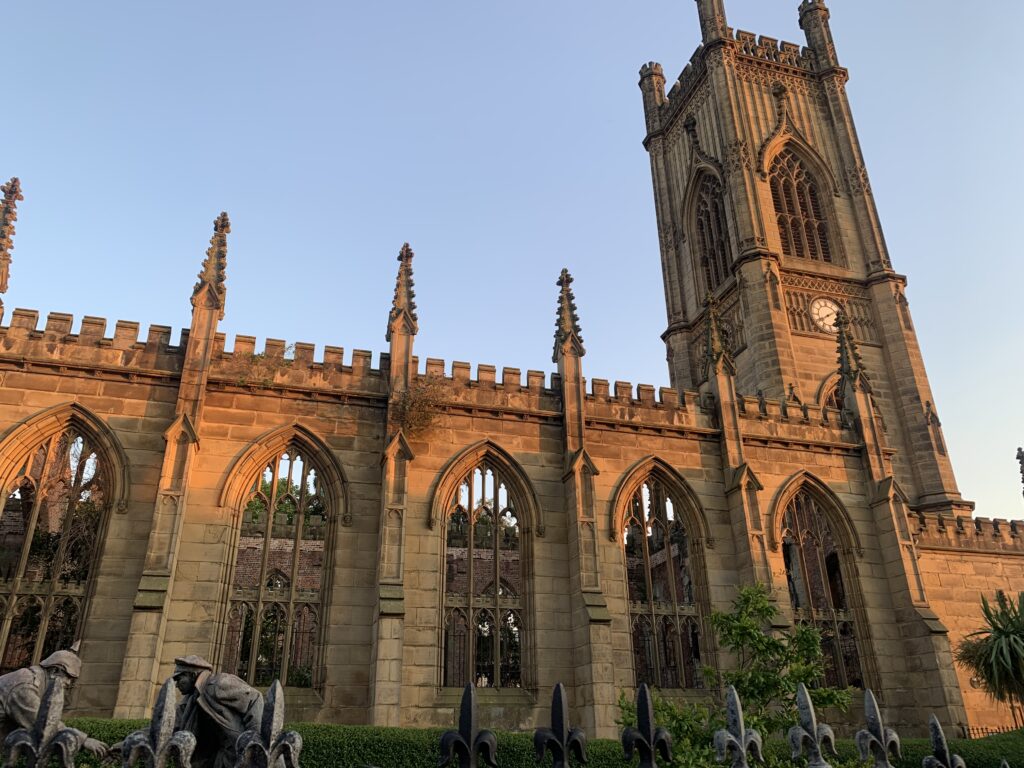
St Luke’s Church, affectionately known as the Bombed Out Church, remains exactly as the Luftwaffe left it following the devastating Blitz of May 1941. Although the exterior walls still stand proudly, the roof was destroyed by incendiary bombs, leaving the church open to the sky. Rather than rebuilding it, Liverpool chose to preserve the ruins as a permanent memorial to those who lost their lives during the Second World War. Today, nature has softened the scars, with greenery filling the former nave, while the church hosts concerts, exhibitions and community events that bring fresh life to a place born from tragedy.
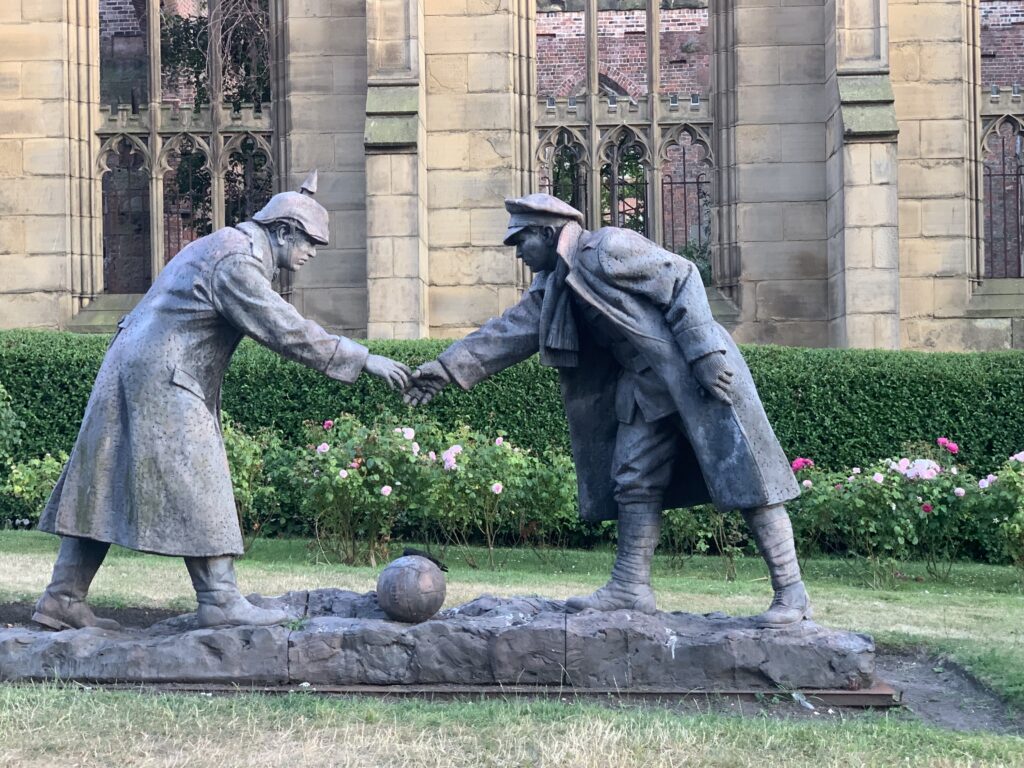
Additionally, in grounds to the side of the church is a beautifully crafted and poignant sculpture entitled All Together Now by artist Andy Edwards. The piece captures the iconic moment on Christmas Day, 1914, when British and German soldiers stopped fighting and played football. It’s become a favourite sight in the city and I would defy anyone not to struggle with emotion at how beautifully Edwards has captured both the detail and the hesitant respect between the enemy soldiers in this detailed work.
In complete contrast to the historic, the Georgian and the Gothic stands St John’s Beacon. Completed in 1969 and built as a ventilation shaft for the shopping centre below, the Beacon stands 400 feet tall and can be seen far into north Wales. It houses a viewing gallery offering magnificent views that are the very definition of “far-reaching” although at the time of writing it’s sadly closed to the public. When planning your visit to Liverpool do check the website to see whether it’s hosting visitors again.
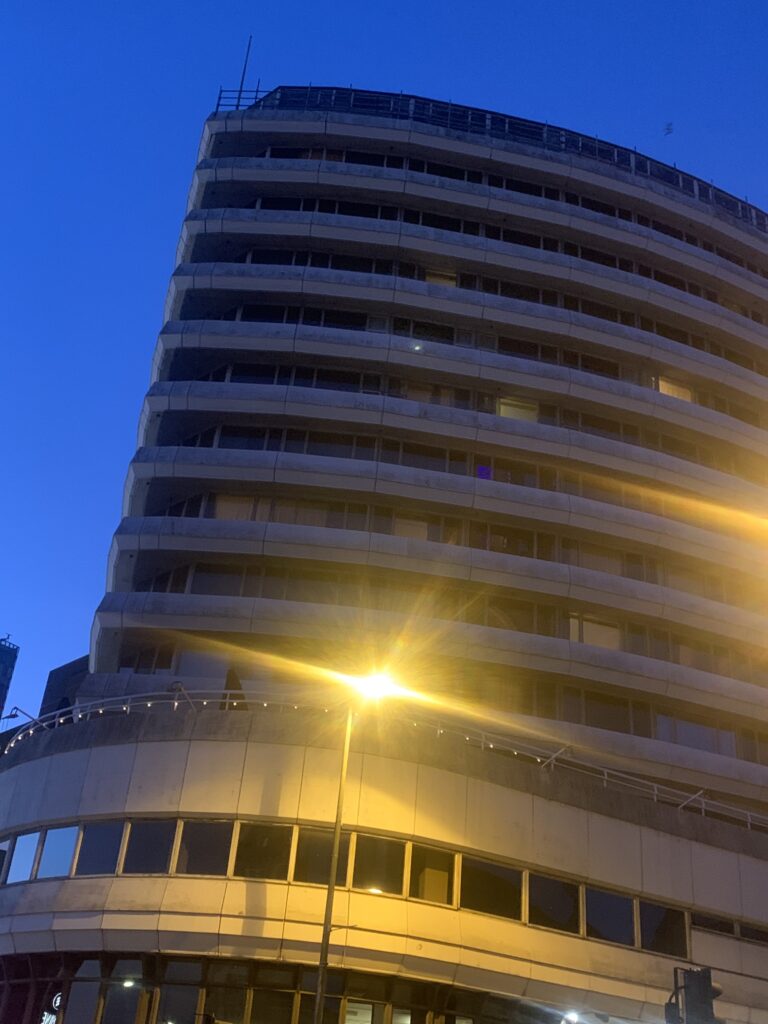
Liverpool’s skyline continues to evolve. Modern hotels such as the Atlantic Tower Hotel, opened in 1973 and built to resemble the prow of a ship. The hotel offers commanding views across the River Mersey and waterfront, its contemporary architecture sitting comfortably alongside the city’s historic landmarks. From its elevated position, visitors can appreciate just how dramatically Liverpool has transformed over recent decades while preserving the character that makes it instantly recognisable. One claim to fame is that Michael Jackson chose the Atlantic Tower as his abode when in Liverpool on his 1988 ‘Bad’ tour. He and his chimp, Bubbles, stayed in the Port of Liverpool suite.
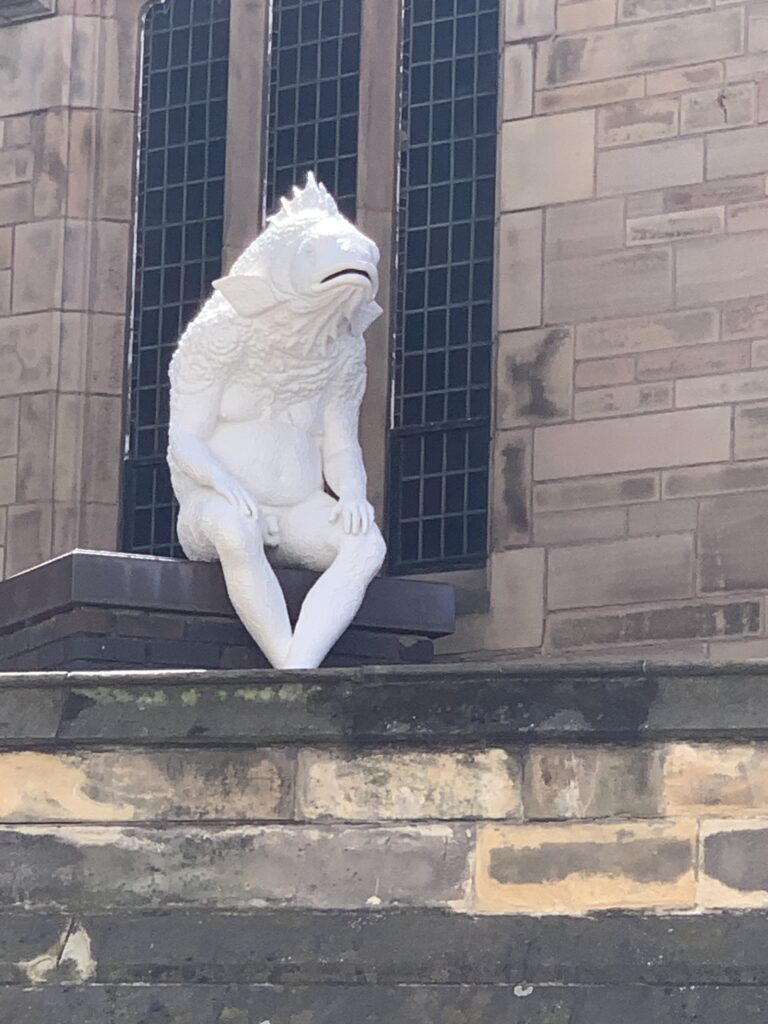
Across the road from the hotel is the church of Our Lady and Saint Nicholas with its interesting (and once tragic) history, lovely gardens through which visitors can stroll. More unusually, the church is currently home to one of the city’s strangest art pieces. Skalli, by local artist Patric Rogers, is a prize-winning sculpture of part human/part fish, drawn from folklore. By the time you visit, it may have moved as the plinth on which it sits houses the winning entry each year, so Skalli only has his moment of glory for 12 months.
Perhaps Liverpool’s greatest architectural achievement is that it has resisted the temptation to replace history with modernity. Instead, it has woven the two together. Grand Victorian warehouses stand beside glass-fronted museums. Gothic cathedrals overlook contemporary developments. Historic docks have become thriving cultural quarters rather than forgotten industrial relics.
The result is a city that feels authentic rather than manufactured. Every building, whether centuries old or freshly completed, contributes another chapter to Liverpool’s remarkable story.
For visitors, that means there is always something new to discover around the next corner. Whether admiring the grandeur of the Three Graces, wandering the cobbled quays of the Albert Dock, standing beneath the soaring vaults of the Anglican Cathedral, reflecting quietly within the ruins of St Luke’s, Liverpool or stumbling upon strange fishy-humanoid creations Liverpool reveals itself as far more than simply the home of The Beatles.
It is a city built on ambition, resilience and reinvention—and nowhere tells that story better than its architecture.


That’s a really lovely way to describe it – I’ve always been struck by how much of Liverpool’s past is still visible just walking around.