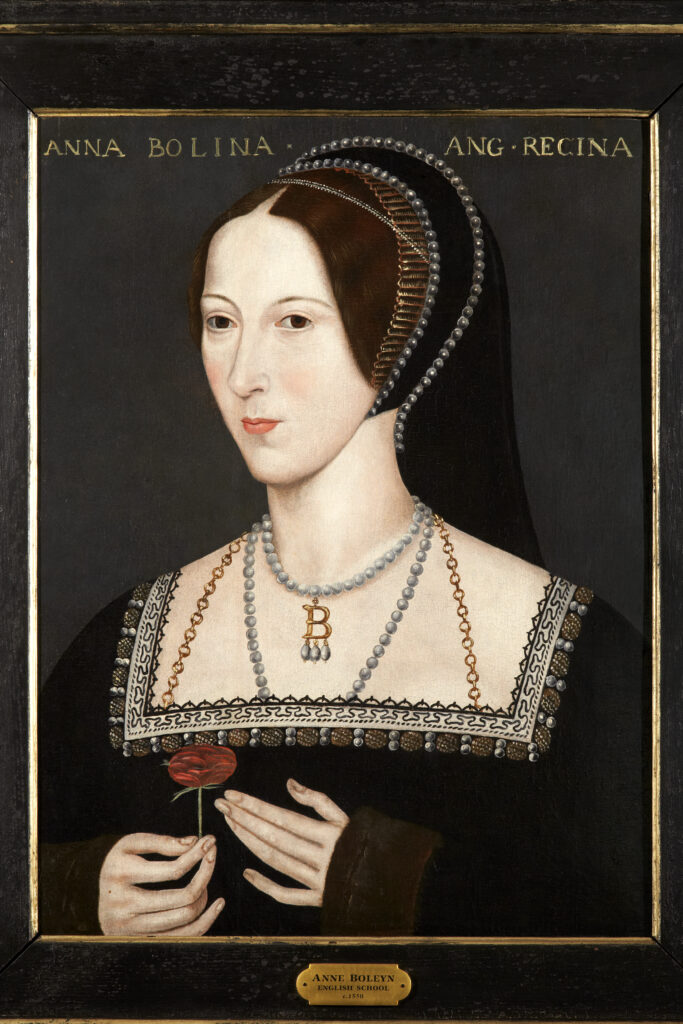
A rarely seen and much-discussed portrait of Anne Boleyn has arrived at Hever Castle this season, as the so-called Lyndhurst Portrait takes its place in the Capturing a Queen exhibition.
On loan from New York and long associated with the National Trust for Historic Preservation collection, the painting offers visitors a rare chance to encounter one of the more intriguing depictions of Anne and to consider how her image has been interpreted, repeated and reshaped over centuries.
The oil on panel work shows an adult female sitter against a plain brown background, seated behind a richly embroidered red cushion. She is turned slightly to the left, her face finely detailed with a high forehead, softly arched brows, and delicately modelled features. Her reddish-brown hair is worn in a centre part beneath a black French hood, set with rows of pearls, alongside a veil and coif typical of Tudor court dress.
Her costume is rendered in extraordinary detail, layered with black fabrics, embroidered blackwork, and glimpses of richer textiles beneath. At her neck are multiple strands of pearls and a distinctive gold “B” pendant, also suspended with pearls – a detail that has long attracted scholarly attention. Across the top of the panel, an inscription identifies the sitter as “ANNA REGINA VXOR 2A H 8,” naming her as Anne Boleyn, second wife of Henry VIII.
The portrait is traditionally associated with the Flemish-born artist Johannes Corvus, recorded as working in England during the 1520s, and it has passed through a complex provenance before becoming part of the Lyndhurst estate in the United States.
Today, its arrival at Hever Castle feels particularly resonant. As Anne Boleyn’s childhood home, Hever offers a uniquely fitting setting for examining how her image has been constructed and reconstructed over time.
The Lyndhurst Portrait has, thanks to the recent research of Lee Porritt, been connected to a photograph taken in 1926 at the Howard Young Gallery in New York. That photograph is now held in the Frick Photograph Archive and shows a painting of Anne Boleyn that matches the Lyndhurst panel.
For the Capturing a Queen exhibition, the Lyndhurst painting underwent an extensive conservation treatment that restored the portrait to its original brilliance. During the process, conservators uncovered evidence of several aggressive past restoration attempts, including overpainting on the sitter’s hair and background.
With these later additions now removed, the Lyndhurst Portrait now bears an even closer resemblance to the portrait photographed at the Howard Young Gallery. The recent discovery of the painting’s original receipt of purchase has also confirmed that it is the very same work shown in the Howard Young Gallery photograph.
What makes the Lyndhurst Portrait especially compelling within the Capturing a Queen exhibition is its striking visual relationship to other well-known depictions of Anne – most notably the Hever Rose Portrait. The similarities in facial structure, posture and presentation invite comparison, while the recurring use of pearl jewellery and the distinctive “B” motif across both works has become a recognisable visual thread in the evolving iconography of Anne Boleyn.
These repeated patterns – the pearls, the French hood, the composed profile – speak less to a single definitive likeness and more to a shared artistic language that developed around Anne’s image in the Tudor period and beyond. In that sense, the Lyndhurst Portrait doesn’t simply present Anne as she was seen, but as she has been continually reinterpreted.
Displayed within the historic surroundings of Hever Castle, the painting becomes part of a wider conversation about memory, identity and representation. Visitors are invited to look closely, compare, and question, not only how Anne Boleyn may have appeared, but how her image has been carefully shaped across generations.
The Capturing a Queen exhibition brings together portraits and artistic interpretations spanning centuries, offering a rare opportunity to trace the evolution of one of history’s most enduring figures.
‘Capturing A Queen: The Image of Anne Boleyn’ is included as part of Castle admission. The exhibition is open to the public until 1st January 2027.
Further information and tickets are available at Hever Castle


