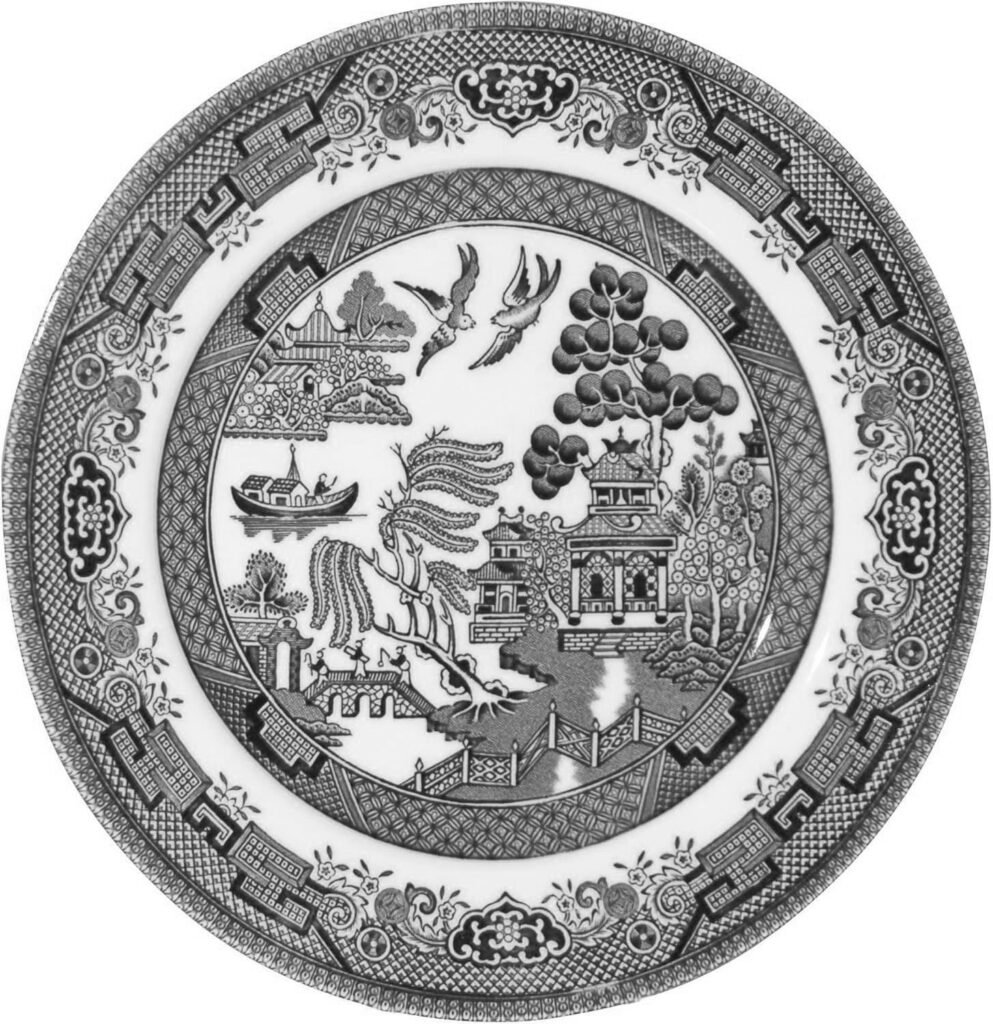
 During the 1950s I was obliged to spend a couple of weeks of the school summer holidays with an aunt in Brighton and all her crockery, from egg cups to dinner plates was blue-and-white Willow Pattern. Even in the 1950s it seemed old fashioned, rather like my aged aunt. In fact the crockery appeared in a number of films and TV series to evoke a nineteenth century atmosphere. On a recent visit to the Victoria and Albert Museum, London, I came across a display of the china with details of the fable interpreted by the scene.
I had always imagined the design to be from China, but no, a British innovation from around 1870 created by engravers Thomas Turner and Thomas Minton based on Chinese ceramic originals, imported from Qing Dynasty China, that included scenes with willow trees, boats, pavilions and birds. Josiah Spode refined the formulae for bone china and his son, also named Josiah, popularised and mass produced the Willow Pattern throughout the Victorian era. The Orient was much in vogue in the nineteenth century and to help market the design a romantic fable was created to charm the Victorian public.
A wealthy Mandarin’s beautiful daughter (Koong-Se) loved a humble servant (Chang), but her father had arranged her marriage to a powerful duke. On the eve of her marriage, the duke arrived by boat to claim his bride and presented a box of jewels as a dowry to her father. Chang stole the jewels and he and Koong-Se are shown running across the bridge to freedom pursued by her father, whip in hand. The lovers escape using the duke’s boat, sailing to a small remote island where they live happily for many years. However, the duke sought revenge, discovered their whereabouts and sent soldiers to capture the couple and put them to death. The Gods, moved by this injustice, morphed the lovers into swallows which are pictured amorously flying together symbolizing the lover’s eternal union.
This final version of the tale appeared in 1849, not an entirely original story, borrowing the plot from the Japanese fairy tale The Green Willow and ideas from other fairy tales originating in China. However, it charmed the Victorian public and ensured the Willow Pattern’s success in Britain, the colonies and America.
Hundreds of manufacturers have produced the pattern for over two hundred years and it remains the most recognised and continuously produced china design worldwide.


