‘The music is not in the notes, but in the silence between.’
Wolfgang Amadeus Mozart
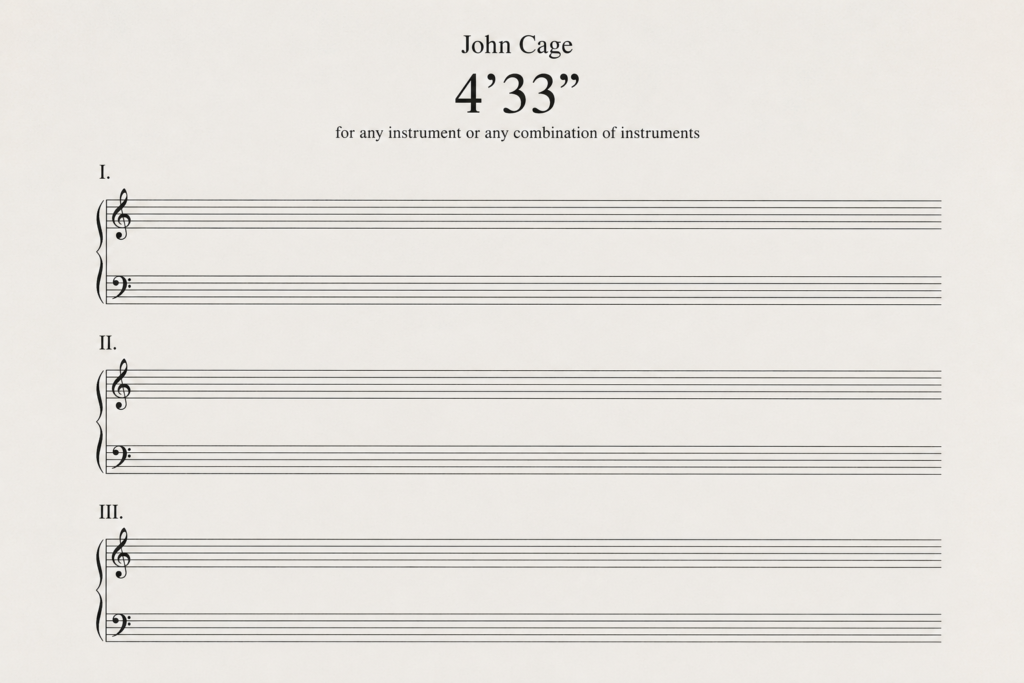
Anyone could compose and notate silence, but surely no one would publish it. However, in 1952 John Cage got his version performed, recorded and published, all 4’33” of it, quite a feat of persuasion of recording company bosses. The CD cost £4.33 of course. So, was the work a satirical swipe at the concept of performance? A work of profundity or Jest? A brazen publicity stunt? Or a conman taking the proverbial piss? Actually, none of these. So, what is the basis of the most notorious ‘composition’ of the twentieth century?
4’33” was initially performed as a piano solo in three movements, a degree of jest here I suppose. The pianist enters the stage, bows to acknowledge the audience applause, sits at the piano, adjusts the seat height, opens the score, shuffles and settles down to play nothing for four-and-a-half minutes. He then rises, again bowing to the audience and exists stage left (to rapturous applause?).
In the same year Cage devised Water Music, in which a pianist performs many sound-creating chores near and around a piano, including pouring water and switching on a radio, but does not actually play the instrument. The creation of random elements of sound were a feature of Cage’s compositions, whether it be tossing a coin to determine the order of notes or adopting household appliances (e.g. vacuum cleaner) into the orchestra. Cage also engaged with cacophony by the playing of two or more different pieces simultaneously.
Cage maintained that all sounds have significance to the listener and not just those created from interpreting musical notation. When we listen to a composition by, say Beethoven or Mozart, we are passive listeners, submitting to the composers will and structural (e.g. sonata form) formulae. Cage’s objective was to liberate the listener by attempting to create sounds free of the dictatorial imperative of musical form and the composer’s volition. In many instances the results only qualify as music by applying a kind of Alice-in-Wonderland logic.
As I sat to write this account I listened to 4’33”; the ‘silence’ was deafening. I heard my breathing, a clock chimed the hour not allowing time to pass quietly, a breeze ruffled a curtain, a seagull screeched from a neighbour’s roof, a car cruised by, the postman rang the doorbell introducing a rhythmic coda. This is not music in the classic sense and by effacing the composer these sounds have no form, no structure to make sense of the random sounds.
4’33” is more of an experiment than a composition, questioning the very notion of music. It’s not a piece during which nothing happens but an invitation to listen to all the sounds present when an audience sits in ‘silence’: a muffled cough, a whispered comment, a sigh of frustration, the rustle of clothing, the crackle of a sweet wrapping, the drone of air conditioning, and so on. 4’33” is a pretext for receptive listening, embracing the idea that sound, ambient noise, emerges from silence; there is never total silence. The work is universally misunderstood, considered either a joke or an affront when performed before a live audience. But Cage was informing us that there is musicality to the world about us, if only we will devote four-and-a-half minutes to listen.
In 2002, singer-songwriter Mike Batt composed A One Minute Silence which was literally what the title suggested. The Mechanical Copyright Protection Society, on behalf of John Cage’s heirs, sued Batt for plagiarism of 4’33”. Batt settled out of court but later alleged the dispute had been a publicity stunt.
As radical as it was, Cage’s work was not the first composition of silence. Czech composer and pianist Erwin Schulhoff pioneered ‘silence’ in music over thirty years before Cage’s 4’33”. His piano piece Fűnf Pittoresken, contains a movement of silent reflection.
Yves Klein, French artist noted for producing Klein Blue, a deep blue pigment reminiscent of lapis lazuli, conceived his Monotone Silence Symphony in 1948 which included twenty minutes of silence. However, during the 1960 premiere in Paris he provided the audience with a welcome distraction. Three naked women doused themselves in his signature blue paint and produced imprint ‘portraits’ by pressing their bodies onto paper. Perhaps an illustration of Mozart’s contention that it’s the naked spaces that give music meaning.


