 Quite early one morning, whilst on a five day business car safari around Uganda, I stood on the bank of the River Nile at Nimule. a few miles from where that great river leaves Uganda and crosses the border into Sudan. By this point, it has flowed over four hundred miles through Uganda from the Jinja Dam and has about three thousand miles to go before entering the Mediterranean Sea alongside Egypt.
Jinja Falls, on Lake Victoria, being the only outlet of water from the Lake used to be thought of as the origin of the Nile after its discovery for the world by British explorer John Hanning Speke in 1862 as it tumbled out of Lake Victoria to become thought of as the longest river in the world. Jinja Falls is now a modern Dam and the only outlet of water from the Lake, although modern geography places the Nile source as the Ruwenzori Mountains and the Kagera River which starts as a trickle in the fabled Mountains of the Moon, as the Ruwenzoris are also historically known.
The Kagera is seen as the modern border between Uganda and Tanzania but somehow used to be ignored by geographers as the Nile source, despite being the only body of water that enters Lake Victoria and, amazingly, recognised by the ancient Greek geographer Ptolemy as the beginning of the Nile. He even drew quite accurate maps showing the Kagera, Lake Victoria and the Jinja outlet. How did he know? There is no evidence of Europeans in the area before Speke found Lake Victoria. Ptolemy lived and worked in Alexandria, Egypt, around AD150 and gave the snow-covered Mountains of the Moon name to that long range of mighty hills.
Ptolemy thought the Nile passed through two Lakes to begin its journey to Egypt. He almost got that right. The Nile passed through Lakes Victoria, Kyoga and Albert before setting out towards Nimule, The Sudan and Egypt.
I know the whole area very well, having lived in Uganda and travelled everywhere on business using cars, light aircraft and Lake steamers.
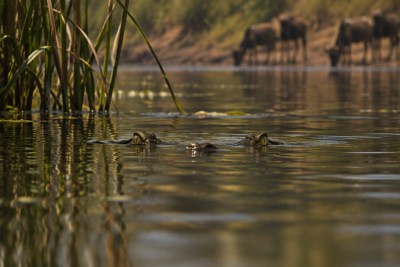
On this particular day I stood on the bank of the Nile by my car, waiting for the single small ferry to return from the other side, thinking of Ptolemy and studying the river passing slowly by. So wide and gentle at this point it could have almost been thought of at first sight as a lake, had the water not been peopled by crocodiles. I stayed away from the river’s edge, because they hide under the surface, with just the tip of their nose and eyes out of the water. Unless you notice them taking in your scent and watching you without moving, if you don’t concentrate it is easy to see them as floating logs.
Seeking food, they crash out of the water at amazing speed and take a drinking wildebeest or gazelle in a second to be killed by those horrible great teeth or dragged down and drowned. Not wishing to be a crocodile’s breakfast I stood well back, behind my car and about thirty local tribesmen and women also awaiting the ferry.

At this point the great river is over nine hundred and fifty yards wide. I could hear the puttering sound of the ferry engine echoing off the still water, then saw the boat emerge from the morning mist.
It ran up the bank, and the crowd of Africans stood aside while the pilot put out a strong wooden ramp for me to drive up, then they boarded the ferry, surrounding my car, chatting to each other. We set off for the other bank.

The ferry consisted of two rusty metal hulls kept apart by wooden posts and a small open cabin at the stern, where the captain sat and steered. It travelled very slowly with the captain half asleep and by the time we were halfway across I noticed we were listing to port. I concentrated on the port hull for a few minutes and saw it definitely sinking.
I pointed the problem out quietly to the captain. He jerked awake; saw his ship was going down and panicked. He jumped from his bench, climbed onto the sinking hull and prepared to dive into the water, abandoning boat and passengers.
Immediately I took command.
I yelled at him in Swahili, “Stay with the ferry you idiot. Remember the crocodiles.”
He jumped back into the cabin and stared at me in fear. The African passengers also began to panic and started rushing from one end of the deck to the other, shouting in fear. In a loud voice I told them, in fluent Swahili, to keep still. They obeyed the only European on board immediately and, although still very frightened, they controlled themselves and froze.
I chose a big strong tribesman with a bucket and, with the captain’s help, unscrewed the lid of a wide rusty manhole on the deck of the hull. I sent him down into the dark interior with instructions to bail like mad and get the water out. Another man jumped onto the hull, took each bucketful and ditched it back into the river.
Every passenger was, by now, deadly silent, watching our two saviours working to keep the ferry from capsizing. It was obvious that more water was coming into the hull than was coming out. A number of passengers were praying quietly and watching the crocodiles moving towards us.
In Africa the animals are very clever and know how to survive. These enormous crocs realised we were in trouble and may soon be in the water and available for an early lunch.
The ferry slowly tipped left with water beginning to trickle over the hull deck, but at the same time we heard the keel scrape the river bottom. I shouted ‘Move to the right of the deck.’
Every passenger did so at speed, hanging onto the rail and leaning out of the boat to bring the port hull higher.
Our captain gave the engine the biggest surge of power possible and pushed us far enough up the bank to run and get his ramp out. Every African passenger rushed off that ferry in seconds. I got into my car and drove carefully down the ramp and up the bank. The passengers surrounded me, clapping and shouting their thanks, the women making that high Yuluyulu sound they use when something important has happened.
I drove away, waving out of my window. Only then did I feel fear and my heart beating at high speed. I suppose concentrating on saving my life and, I think about thirty other lives kept me in deep concentration, because I do not remember being frightened while making sure we all got ashore.
I looked back and saw about twenty sets of crocodile eyes staring from the water. Did they look disappointed at missing a large early lunch?
I couldn’t tell.


